

LIBRE TELESCOPE
Menu
Book Event

Quick Stats

Name:
Ariel
Type:
Object
Observability:
Expert
Best telescope for viewing:
Libre Telescope’s 25-inch reflector — to distinguish Ariel’s faint point from glare around Uranus.

How to view Ariel

  1. Wait for separation

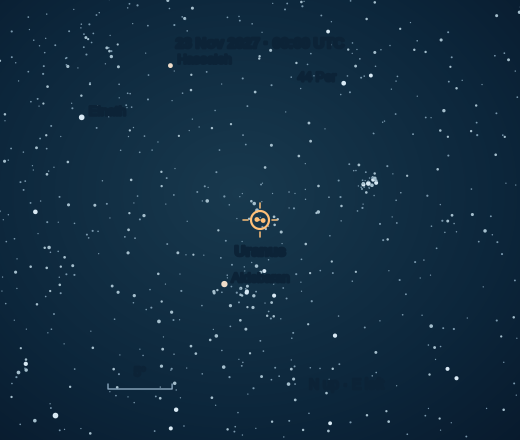
    Try November 23–December 7, 2027 and look up the position of Ariel for your actual observing hour. Choose a time of wide separation from Uranus when the planet is high at your West Coast site.

  2. Match the moon pattern

    Center Uranus at low power. Rotate the predicted satellite configuration to match the eyepiece, then identify Ariel by its distance and side relative to the planet.

  3. Check the motion

    Save the time and field orientation with your sketch or image. Compare it with the next observation and the predicted orbit of Ariel.

A closer look at Ariel

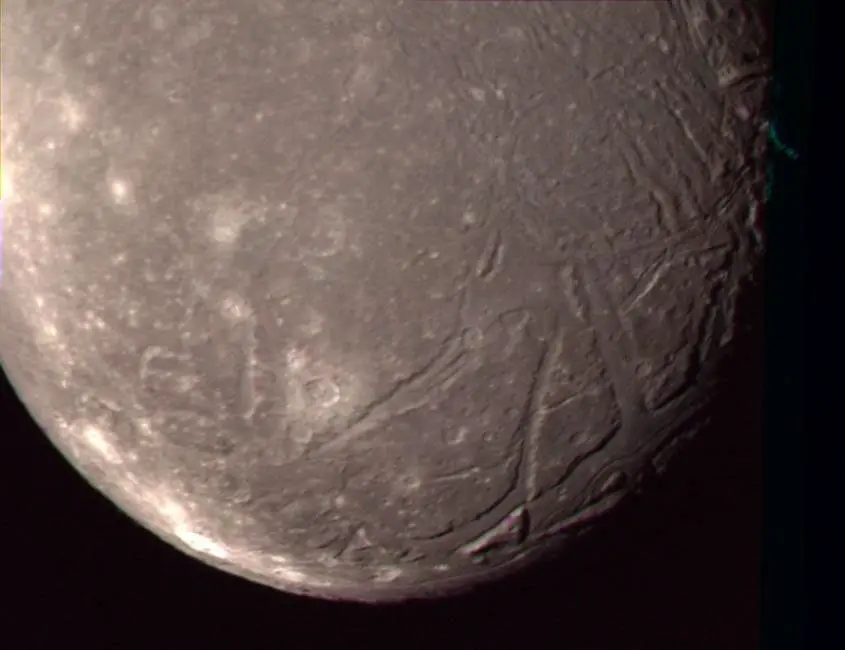
Ariel has a bright icy surface cut by valleys and fractures. Voyager’s images show that portions of the moon have been resurfaced after the earliest heavy impacts.

Ariel takes about two and a half days to orbit Uranus. Its diameter of roughly 1,160 km is comparable to Umbriel’s, but the two reflect different proportions of the sunlight falling on them.

The surface remains unresolved from a standard observing event. Look for a faint moving point at the predicted separation from Uranus.