

LIBRE TELESCOPE
Menu
Book Event

Sky Guide

The Southern Pleiades

IC 2602

Quick Stats

Name:
The Southern Pleiades (IC 2602)
Type:
Object
Observability:
Naked eye
Best telescope for viewing:
Celestron Cometron 7×50 binoculars — for a field wide enough to include the main group and outlying stars.

How to view IC 2602

  1. Choose a southern observing site

    At declination 64.4° south this field stays below the horizon across the contiguous U.S. West Coast. Use a southern observatory’s images or observe through a remote telescope farther south.

  2. Find the field

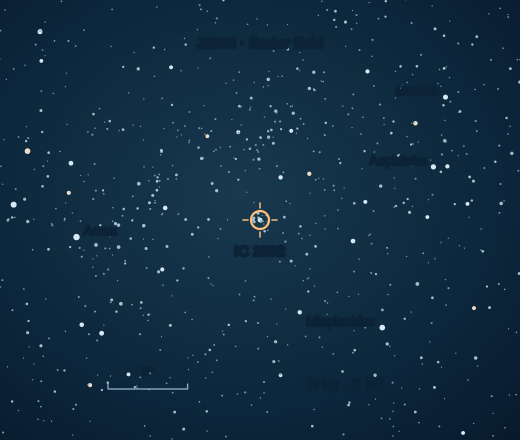
    On the north-up chart, start at Miaplacidus. The target lies about 10.2° east of it. Match the surrounding stars before changing magnification.

  3. Check the identification

    The catalogued long axis is 48 arcminutes. Keep a few field stars beyond the cluster in the eyepiece. Compare the density in the middle with the density near the edge.

Best telescope for viewing IC 2602: Celestron Cometron 7×50 binoculars — for a field wide enough to include the main group and outlying stars. on Amazon

A closer look at IC 2602

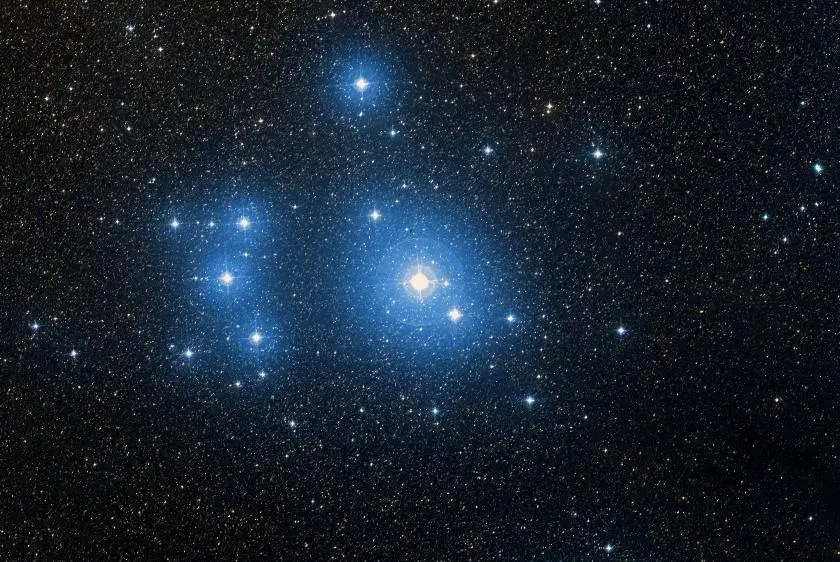
Theta Carinae anchors the Southern Pleiades. From a suitably southern latitude, the brightest members can be picked apart by eye before binoculars reveal how widely the group spreads.

Astronomers can separate travelers moving with the cluster from stars merely crossing its field. The Gaia-based census lists 311 high-probability members and estimates an age of 36 million years at about 490 light-years.

Mark Miaplacidus in the finder. A sweep of about 10.2° east brings the catalogue position into the field. Keep a few outlying stars in the field when sketching the group, so its scale is preserved.