

LIBRE TELESCOPE
Menu
Book Event

Sky Guide

NGC 1783 in Dorado

Quick Stats

Name:
NGC 1783 in Dorado
Type:
Object
Observability:
Difficult
Best telescope for viewing:
Sky-Watcher Classic 250P 10-inch Dobsonian — to distinguish this faint cluster’s core from foreground stars.

How to view NGC 1783 in Dorado

  1. Choose a southern observing site

    At declination 66.0° south this field stays below the horizon across the contiguous U.S. West Coast. Use a southern observatory’s images or observe through a remote telescope farther south.

  2. Find the field

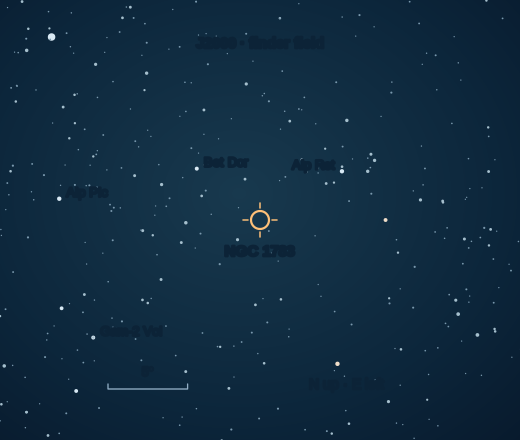
    On the north-up chart, start at Canopus. The target lies about 17.0° southwest of it. Match the surrounding stars before changing magnification.

  3. Check the identification

    The catalogued long axis is 5.3 arcminutes. Increase the power in small steps and watch for outer stars separating from the smoother central glow.

Best telescope for viewing NGC 1783 in Dorado: Sky-Watcher Classic 250P 10-inch Dobsonian — to distinguish this faint cluster’s core from foreground stars. on Amazon

A closer look at NGC 1783 in Dorado

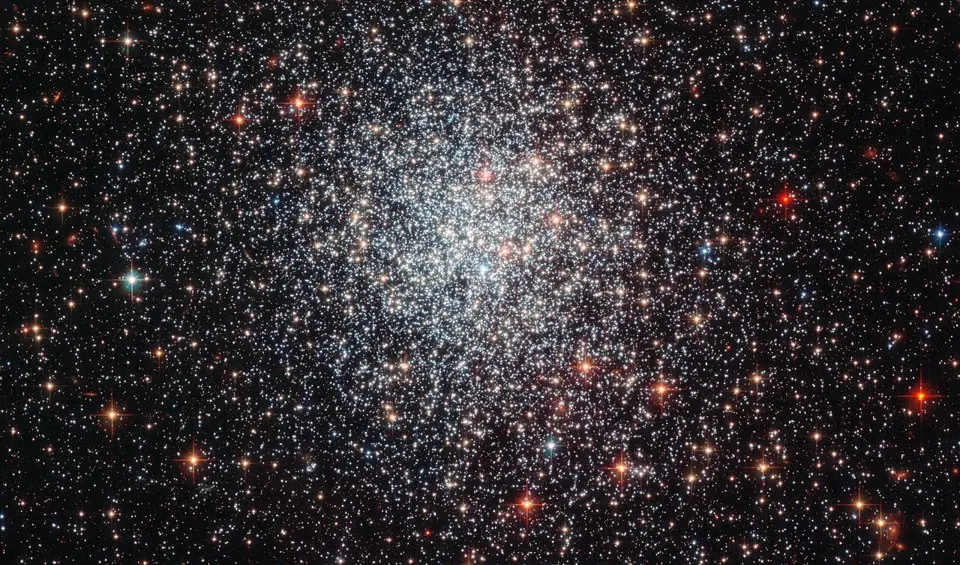
This large, populous cluster belongs to the Large Magellanic Cloud. Its fairly symmetric outline suggests a globular even though its stellar population differs in age from ancient Galactic examples.

Follow a line outward from the center and watch the density of stars change. The surrounding field belongs to the same external galaxy.

Begin your chart search at Canopus, then move about 17.0° southwest to the target field. Its catalogued span is 5.3′ × 4.7′.

Want to learn more about NGC 1783 in Dorado? NGC 1783 on Wikipedia.