

LIBRE TELESCOPE
Menu
Book Event

Sky Guide

Large Magellanic Cloud

Quick Stats

Name:
Large Magellanic Cloud
Type:
Object
Observability:
Naked eye
Best telescope for viewing:
Celestron Cometron 7×50 binoculars — for the star clouds and overall outline from a southern latitude.

How to view Large Magellanic Cloud

  1. Choose a southern observing site

    At declination 69.8° south this field stays below the horizon across the contiguous U.S. West Coast. Use a southern observatory’s images or observe through a remote telescope farther south.

  2. Find the field

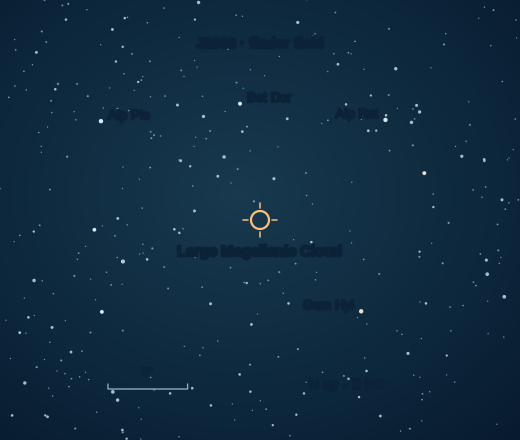
    On the north-up chart, start at Canopus. The target lies about 18.5° south of it. Match the surrounding stars before changing magnification.

  3. Check the identification

    From a southern site, outline the cloud by eye. Scan across it in binoculars and compare the bright stellar patches with the darker surroundings.

Best telescope for viewing Large Magellanic Cloud: Celestron Cometron 7×50 binoculars — for the star clouds and overall outline from a southern latitude. on Amazon

A closer look at Large Magellanic Cloud

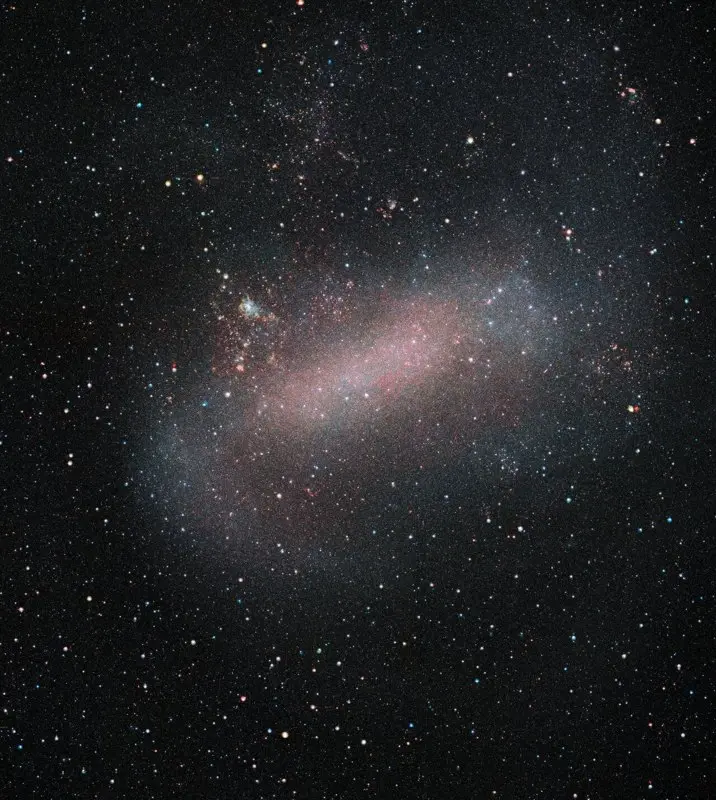
The Large Magellanic Cloud looks like a detached piece of the Milky Way from a dark southern site. It is a neighboring galaxy in its own right.

Its irregular outline encloses star-forming regions and clusters. An infrared survey can pick out stars behind dust that dims visible light.

Begin with the unaided eye to appreciate its extent. Then sweep it with binoculars instead of trying to fit the entire galaxy into a high-power eyepiece. On a wide-field chart, NGC 1898 in Dorado lies about 33 arcminutes from this target. Use an eyepiece with a wide field of view to match the surrounding pattern of stars to the finder chart.

Want to learn more about Large Magellanic Cloud? Large Magellanic Cloud on Wikipedia.