


LIBRE TELESCOPE
Menu
Book Event

Sky Guide

Neptune

Quick Stats

Name:
Neptune
Type:
Object
Observability:
Difficult
Best telescope for viewing:
Sky-Watcher Classic 200P 8-inch Dobsonian — to inspect Neptune’s minute disk after a chart-based identification.

How to view Neptune

  1. Check the evening sky

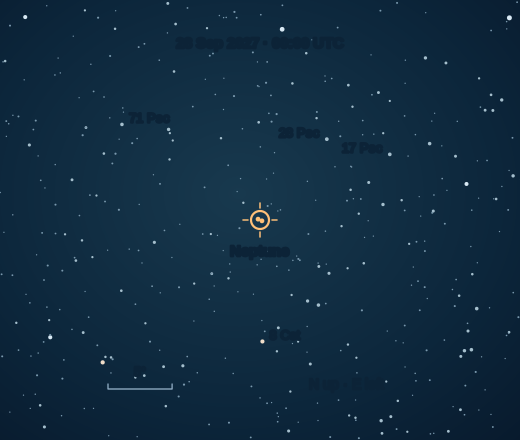
    Try September 24–October 3, 2027. Use your West Coast city and Pacific local time to find when Neptune reaches its greatest altitude in darkness.

  2. Center the planet

    Use a chart for that date to match Neptune to the surrounding stars. Start at your lowest power and focus on the edge of the disk.

  3. Inspect the disk

    Identifying the moving point is a more realistic first goal than resolving weather on its surface.

Best telescope for viewing Neptune: Sky-Watcher Classic 200P 8-inch Dobsonian — to inspect Neptune’s minute disk after a chart-based identification. on Amazon

A closer look at Neptune

The outermost planet is hidden from the unaided eye. From a backyard telescope it looks much more like a point than the broad disk familiar from spacecraft pictures.

Astronomers used irregularities in Uranus’s motion to predict where another planet might lie. Neptune was found telescopically in 1846 near the predicted position.

Match the field to a dated chart. Identifying the moving point is a more realistic first goal than resolving weather on its surface. The angular size of a distant body determines how much of its surface a telescope can resolve.

Want to learn more about Neptune? Neptune on Wikipedia.