

LIBRE TELESCOPE
Menu
Book Event

Sky Guide

The Moon at apogee

Quick Stats

Name:
The Moon at apogee
Type:
Event
Observability:
Intermediate
Rarity:
Very common · About every 27.55 days
Date of last occurrence:
Nov 13, 2026
Date of next occurrence:
Dec 11, 2026
Date of occurrence after that:
Jan 7, 2027
Best telescope for viewing:
Celestron StarSense Explorer DX 102AZ refractor — with a camera at fixed focal length to measure the lunar disk at two distances.

Maximum distance · UT · Calendar reference: November 28, 2026.

How to view The Moon at apogee

  1. Choose a local session

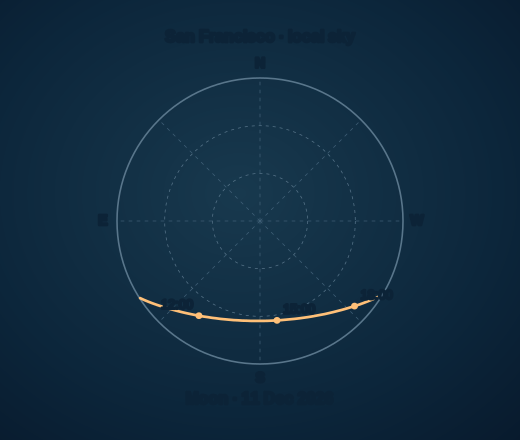
    December 11–12, 2026. Look up local moonrise and moonset for your West Coast city. The date of the exact phase or orbital extreme in UT may differ from the local date.

  2. Frame the whole disk

    Start with the entire lunar disk in view. Use a time well above the horizon to reduce the effects of atmospheric distortion.

  3. Compare the detail

    Compare the Moon’s angular diameter with a perigee image made with the same camera and focal length.

Best telescope for viewing The Moon at apogee: Celestron StarSense Explorer DX 102AZ refractor — with a camera at fixed focal length to measure the lunar disk at two distances. on Amazon

A closer look at The Moon at apogee

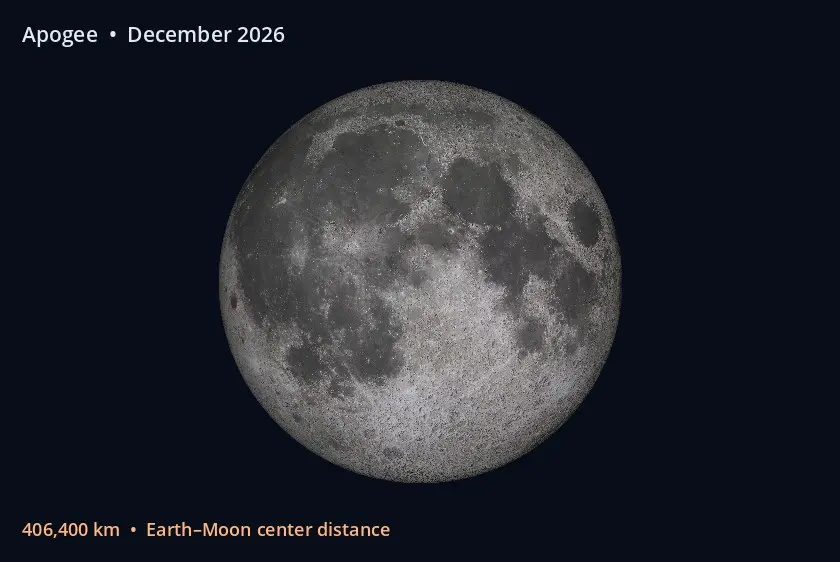
At apogee the Moon reaches its greatest Earth distance for that orbit. Its phase is governed by its direction relative to the Sun, so apogee can occur at widely different phases.

The December 11, 2026 apogee is about 406,400 km from Earth’s center. Compare it with the December 24 perigee and the ratio of distances predicts a visibly measurable change in image scale.

The December apogee occurs shortly after new Moon. The crescent is a tricky diameter target, so fit a circle to its illuminated outer limb or select a later apogee with more of the outline visible.

Want to learn more about the Moon at apogee? Orbit of the Moon on Wikipedia.