

LIBRE TELESCOPE
Menu
Book Event

Sky Guide

Mercury at greatest western elongation

Quick Stats

Name:
Mercury at greatest western elongation
Type:
Event
Observability:
Naked eye
Rarity:
Very common · About three morning elongations per year
Date of last occurrence:
Nov 20, 2026
Date of next occurrence:
Mar 17, 2027
Date of occurrence after that:
Jul 15, 2027
Best telescope for viewing:
Find the planet by eye in twilight, with the Sun below the horizon.

Maximum angular separation · UT · Calendar reference: November 28, 2026.

How to view Mercury at greatest western elongation

  1. Choose the twilight window

    Morning twilight around March 17, 2027. Check the sunrise time at your West Coast site and pick an unobstructed eastern horizon.

  2. Find the planet by eye

    Use a dated local chart to estimate the height of Mercury in twilight. Finish any optical observing before sunrise.

  3. Follow the apparition

    Revisit the same spot over several clear days and record the planet’s height at similar twilight brightness. The highest local altitude need not coincide exactly with greatest elongation.

A closer look at Mercury at greatest western elongation

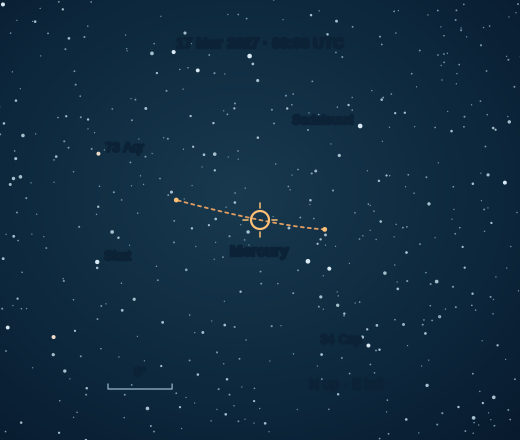
Mercury never strays very far from the Sun in our sky. At greatest western elongation it lies west of the Sun and rises before it, giving observers a chance to find it in morning twilight.

The March 2027 separation is about 28 degrees. How high that puts Mercury above a local horizon depends on the angle of the ecliptic, so the same event can be excellent in one hemisphere and poor in the other.

Pick out Mercury by eye and record its height relative to a distant landmark. End binocular or telescope observing before sunrise. The brightest twilight can swallow the planet well before the Sun appears.

Want to learn more about Mercury at greatest western elongation? Elongation (astronomy) on Wikipedia.