

LIBRE TELESCOPE
Menu
Book Event

Sky Guide

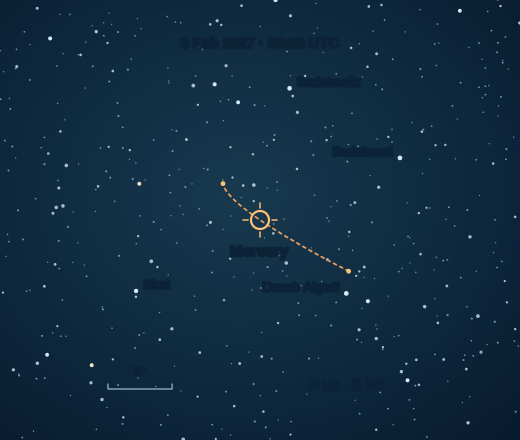
Mercury at greatest eastern elongation

Quick Stats

Name:
Mercury at greatest eastern elongation
Type:
Event
Observability:
Naked eye
Rarity:
Very common · About 116 days between evening maxima
Date of last occurrence:
Oct 12, 2026
Date of next occurrence:
Feb 3, 2027
Date of occurrence after that:
May 28, 2027
Best telescope for viewing:
Find the planet by eye in twilight, with the Sun below the horizon.

Maximum angular separation · UT · Calendar reference: November 28, 2026.

How to view Mercury at greatest eastern elongation

  1. Choose the twilight window

    Evenings around February 3, 2027. Check the sunset time at your West Coast site and pick an unobstructed western horizon.

  2. Find the planet by eye

    Use a dated local chart to estimate the height of Mercury in twilight. Wait until the Sun has fully set before using any optical instrument.

  3. Follow the apparition

    Revisit the same spot over several clear days and record the planet’s height at similar twilight brightness. The highest local altitude need not coincide exactly with greatest elongation.

A closer look at Mercury at greatest eastern elongation

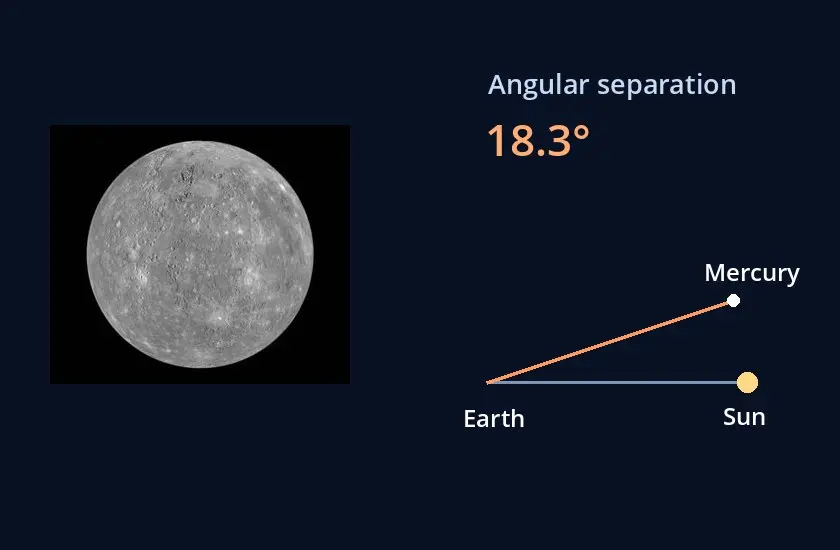
Mercury is an evening object when it lies east of the Sun. Greatest eastern elongation is the point of maximum angular separation in that evening apparition.

The February 3, 2027 elongation reaches only about 18.3 degrees. A steep evening ecliptic can make even a modest separation useful, while a shallow angle keeps Mercury deep in twilight.

Wait until sunset and identify the planet over a clear western horizon. Record the time of first visibility, then return on neighboring evenings to follow the change in height against the fading sky.

Want to learn more about Mercury at greatest eastern elongation? Elongation (astronomy) on Wikipedia.