

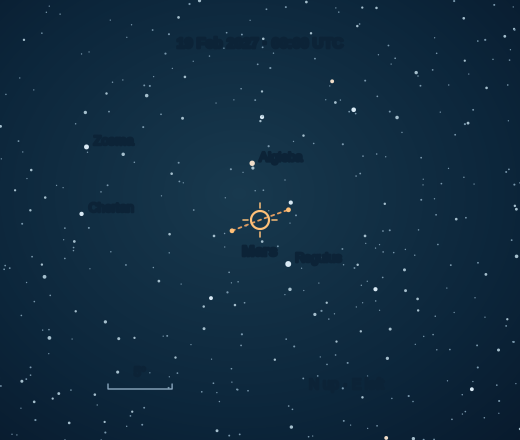

A closer look at Mars at opposition
Look east around sunset near opposition and Mars is rising as the Sun goes down. Earth has caught up with Mars on its shorter, faster orbit. Mars then lies opposite the Sun in our sky and stays above the horizon from dusk to dawn.
Through a telescope the orange point becomes a disk. On a steady night you may catch a pale polar cap or a dark marking that returns to view as the planet turns. In the 1600s, Christiaan Huygens used one of those dark regions, Syrtis Major, to work out how quickly Mars rotates.
Opposition marks an instant, but Mars changes size only gradually over the surrounding nights. For a school or library viewing, pick a clear evening near February 19 and wait for the planet to climb above the horizon haze. A few minutes at the eyepiece can reveal details during moments of steadier air.