


LIBRE TELESCOPE
Menu
Book Event

Sky Guide

Mare Orientale

Quick Stats

Name:
Mare Orientale
Type:
Object
Observability:
Difficult
Best telescope for viewing:
Sky-Watcher Classic 200P 8-inch Dobsonian — for fine lunar relief in steady air and low-angle sunlight.

How to view Mare Orientale

  1. Choose the illumination

    Select a night when libration turns the western limb toward Earth. Check local moonrise and illumination. Pick a time when the Moon is well above the horizon in your city.

  2. Locate the feature

    On a lunar atlas, mark 19.9° S / 94.7° W. Orient the lunar disk in the finder, then move from the nearest broad dark plain or bright crater to Mare Orientale.

  3. Study the detail

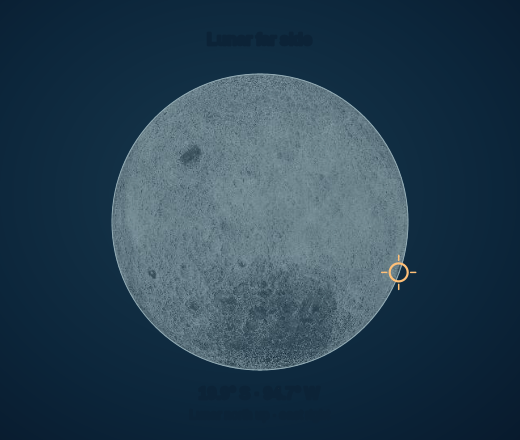
    The centered map gives an overhead view of features seen edge-on from Earth.

Best telescope for viewing Mare Orientale: Sky-Watcher Classic 200P 8-inch Dobsonian — for fine lunar relief in steady air and low-angle sunlight. on Amazon

A closer look at Mare Orientale

The Orientale impact basin preserves a spectacular set of concentric rings around its central dark mare. Most of the structure lies beyond the Moon’s mean western limb.

On a north-up lunar map, the center of Maunder lies about 164 km north of this feature. The IAU catalogue gives 294 km for its extent.

Watch for favorable western libration to reveal fringe terrain and portions of the rings. The centered map gives an overhead view of features seen edge-on from Earth.