


LIBRE TELESCOPE
Menu
Book Event

Sky Guide

The Jupiter–Saturn great conjunction

Quick Stats

Name:
The Jupiter–Saturn great conjunction
Type:
Event
Observability:
Naked eye
Rarity:
Rare · About every 20 years
Date of last occurrence:
Dec 21, 2020
Date of next occurrence:
Oct 31, 2040
Date of occurrence after that:
Apr 7, 2060
Best telescope for viewing:
Celestron Cometron 7×50 binoculars — to frame both planets together during the approach.

Equal ecliptic longitude · UT · Calendar reference: November 28, 2026.

How to view The Jupiter–Saturn great conjunction

  1. Check the predawn horizon

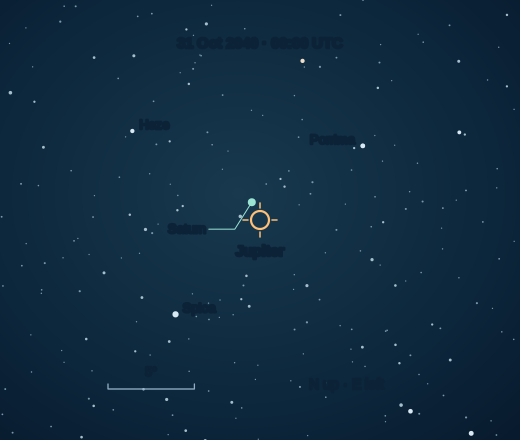
    Late October–early November 2040. Check the separation and height of Jupiter and Saturn before dawn for your West Coast city.

  2. Frame both planets

    Begin by eye and then use binoculars with a field wider than the predicted separation. Finish optical work before sunrise.

  3. Record the approach

    Estimate the gap on several mornings either side of conjunction. Note the date and time of the smallest gap you observe.

Best telescope for viewing The Jupiter–Saturn great conjunction: Celestron Cometron 7×50 binoculars — to frame both planets together during the approach. on Amazon

A closer look at The Jupiter–Saturn great conjunction

Jupiter moves more quickly along its orbit than Saturn. About once every twenty years it catches up in our line of sight, putting both planets in the same patch of sky.

Their apparent separation varies at each encounter. The unusually tight pairing of 2020 was about a tenth of a degree across. The 2040 pair will be much wider.

Follow the two points over several days and record the shrinking gap. Dates here use equal ecliptic longitude. Closest apparent separation can occur on a different date.

Want to learn more about the Jupiter–Saturn great conjunction? Great conjunction on Wikipedia.