

LIBRE TELESCOPE
Menu
Book Event

Sky Guide

A hybrid solar eclipse

Quick Stats

Name:
A hybrid solar eclipse
Type:
Event
Observability:
Naked eye
Rarity:
Rare · 7 worldwide during 2001–2100, uneven gaps
Date of last occurrence:
Apr 20, 2023
Date of next occurrence:
Nov 14, 2031
Date of occurrence after that:
Nov 25, 2049
Best telescope for viewing:
Celestron EclipSmart 50 mm dedicated white-light solar telescope — for a magnified view during the partial phases. For direct unaided viewing, use ISO 12312-2 eclipse viewers.

Central eclipse date · UT · Calendar reference: November 28, 2026.

How to view A hybrid solar eclipse

  1. Check the eclipse path

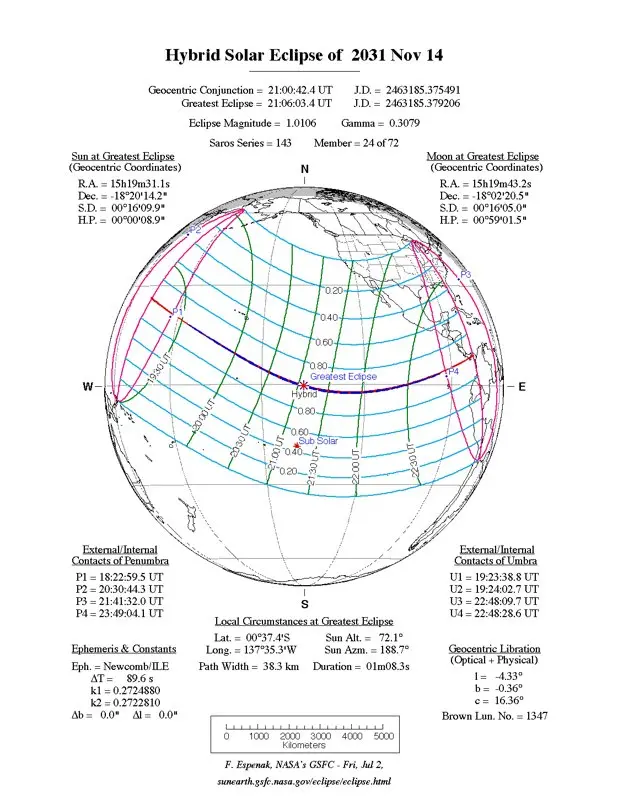
    The narrow central track crosses the Pacific toward Panama on November 14, 2031. Southern California may see a small partial eclipse. Check the circumstances for your exact location.

  2. Choose the viewing method

    Use pinhole projection onto a screen, or an undamaged ISO 12312-2 solar viewer for unaided viewing of the bright solar disk. Never look through the pinhole.

  3. Protect magnified views

    Use a dedicated solar instrument or a purpose-built filter secured over the front of the optics. Keep it fitted. Ordinary eclipse glasses do not protect an eye behind unfiltered binoculars or telescopes.

Best telescope for viewing A hybrid solar eclipse: Celestron EclipSmart 50 mm dedicated white-light solar telescope — for a magnified view during the partial phases. For direct unaided viewing, use ISO 12312-2 eclipse viewers. on Amazon

A closer look at A hybrid solar eclipse

A hybrid solar eclipse occurs when the tip of the Moon’s dark shadow just reaches parts of Earth. Different sections of the same narrow central track can therefore experience either a ring of sunlight or complete totality.

The next hybrid eclipse is on November 14, 2031. Much of the central track crosses open Pacific water, and the annular portion reaches Panama. A location even slightly outside the central track sees a partial eclipse or none.

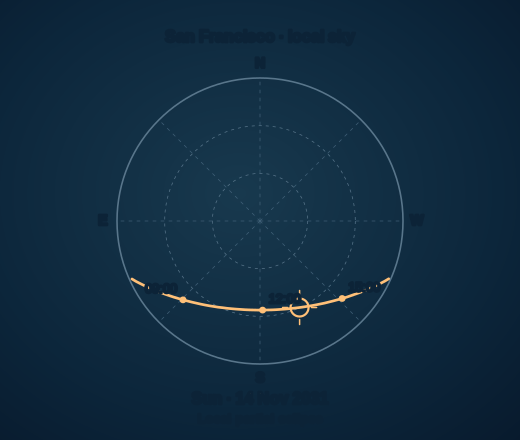
Consult the map for your exact observing location. Use an indirect projection or an ISO 12312-2 solar viewer for every partial or annular phase. Optical instruments pointed at the Sun need a solar filter fitted over the front. A chart of the celestial sphere helps translate an event’s position into a direction from your observing site.

Want to learn more about a hybrid solar eclipse? Solar eclipse on Wikipedia.