

LIBRE TELESCOPE
Menu
Book Event

Sky Guide

An annular solar eclipse

Quick Stats

Name:
An annular solar eclipse
Type:
Event
Observability:
Naked eye
Rarity:
Common · Roughly every 1–2 years worldwide
Date of last occurrence:
Feb 17, 2026
Date of next occurrence:
Feb 6, 2027
Date of occurrence after that:
Jan 26, 2028
Best telescope for viewing:
Celestron EclipSmart 50 mm dedicated white-light solar telescope — for a magnified view during the partial phases. For direct unaided viewing, use ISO 12312-2 eclipse viewers.

Date of greatest eclipse · UT · Calendar reference: November 28, 2026.

How to view An annular solar eclipse

  1. Check the eclipse path

    The February 6, 2027 ring is visible from a narrow path in South America and Africa, outside the U.S. West Coast. Use a broadcast from inside the path or check a travel site against the eclipse map.

  2. Choose the viewing method

    Use pinhole projection onto a screen, or an undamaged ISO 12312-2 solar viewer for unaided viewing of the bright solar disk. Never look through the pinhole.

  3. Protect magnified views

    Use a dedicated solar instrument or a purpose-built filter secured over the front of the optics. Keep it fitted. Ordinary eclipse glasses do not protect an eye behind unfiltered binoculars or telescopes.

Best telescope for viewing An annular solar eclipse: Celestron EclipSmart 50 mm dedicated white-light solar telescope — for a magnified view during the partial phases. For direct unaided viewing, use ISO 12312-2 eclipse viewers. on Amazon

A closer look at An annular solar eclipse

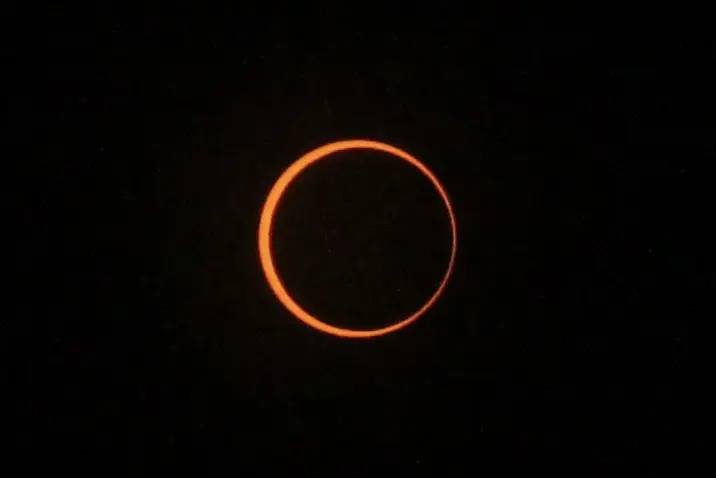
An annular eclipse occurs when the Moon crosses the center of the Sun but looks just too small to cover it. A bright ring remains visible around the Moon.

Only observers in a narrow band see a complete ring. Farther away, the same alignment takes a bite out of one side of the Sun.

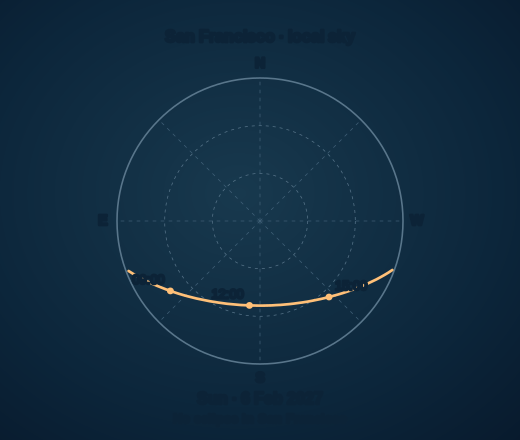
Wear ISO 12312-2 solar viewers throughout, including the ring phase. Telescopes and binoculars require a suitable filter on the front of the optics. Never look through unfiltered optics while wearing eclipse glasses. A chart of the celestial sphere helps translate an event’s position into a direction from your observing site.

Want to learn more about an annular solar eclipse? Solar eclipse on Wikipedia.