
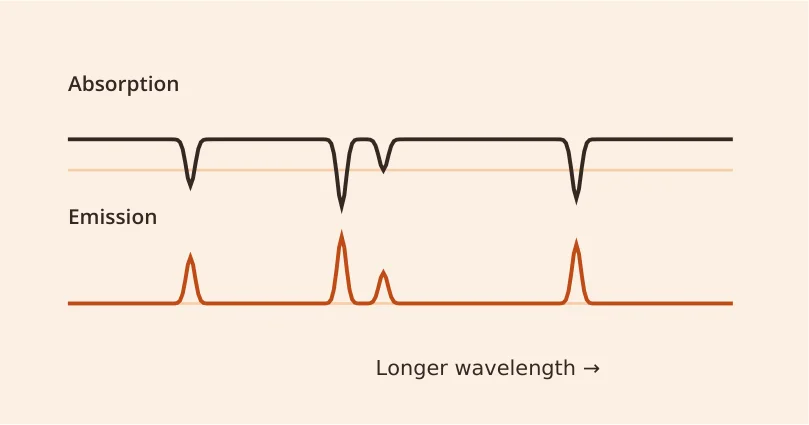
A closer look at Thermal line broadening
Atoms in a hot gas have a distribution of velocities.
Their individual Doppler shifts combine to broaden a spectral line even if the gas as a whole has no bulk motion. Lighter particles move faster on average at the same temperature.
A wide line can also come from turbulence, rotation, or the instrument. Comparing lines of particles with different masses helps test a thermal explanation. This can broaden its spectral lines, a process called Stark broadening.
Want to learn more about Thermal line broadening? Doppler broadening on Wikipedia.