
A closer look at Radial-velocity method
A planet and its star orbit a common center of mass.
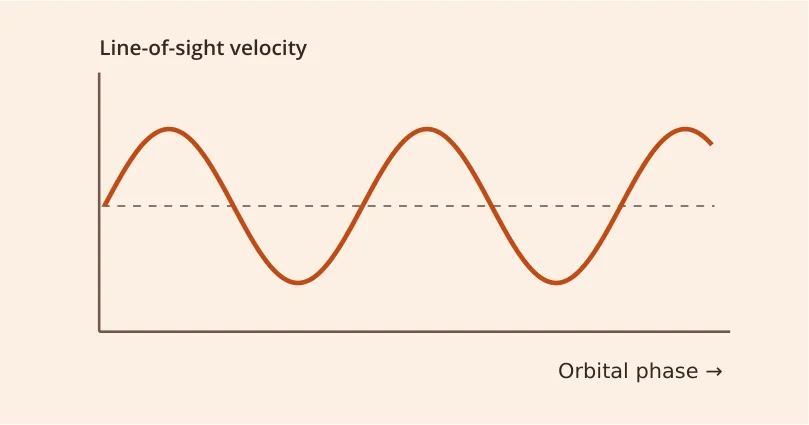
The stellar spectrum shifts periodically as the star approaches and recedes. The signal usually constrains a minimum planet mass unless the orbit’s inclination is known. Radial velocity is the part of a source’s motion directed along the line of sight.
A nearly face-on orbit produces little line-of-sight velocity even for a massive companion. A transiting geometry helps remove this ambiguity. For the surrounding ideas, see Discovery of 51 Pegasi b.
Want to learn more about Radial-velocity method? Doppler spectroscopy on Wikipedia.