
A closer look at Inverse-square law
Radiation spreading equally in all directions crosses a sphere whose area increases with distance squared.
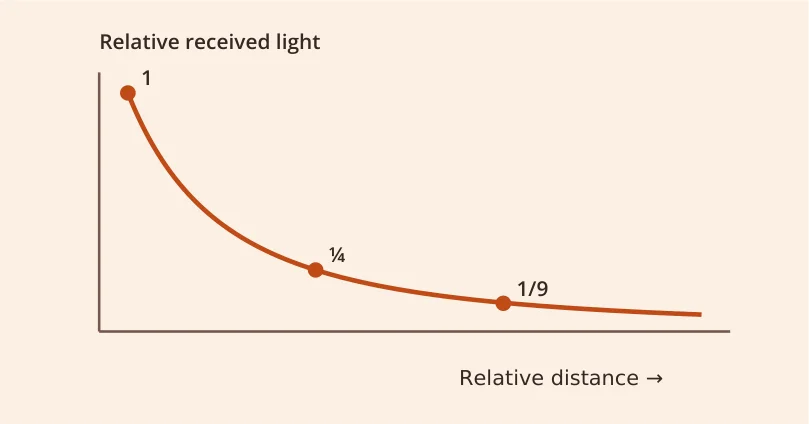
In clear space, the received flux from a fixed luminosity therefore falls with the inverse square of distance. This makes distance modulus a convenient way to express a brightness comparison.
A detector moved three times farther from the same isotropic source receives one ninth the flux, provided nothing absorbs or redirects the light. For the surrounding ideas, see Stellar luminosity.
Want to learn more about Inverse-square law? Inverse-square law on Wikipedia.