

LIBRE TELESCOPE
Menu
Book Event

Sky Guide

WASP-96 b

Quick Stats

Name:
WASP-96 b
Type:
Object
Observability:
Difficult
Best telescope for viewing:
Tracking telescope and calibrated astronomy camera for transit photometry. Use a comparison star in the same field.

How to view WASP-96 b

  1. Check the southern horizon

    At its highest this field is 10° high from San Diego and below the horizon from Seattle. A site farther south gives a clearer view. At coastal latitudes, terrain and haze can conceal it even when it rises.

  2. Identify the host star

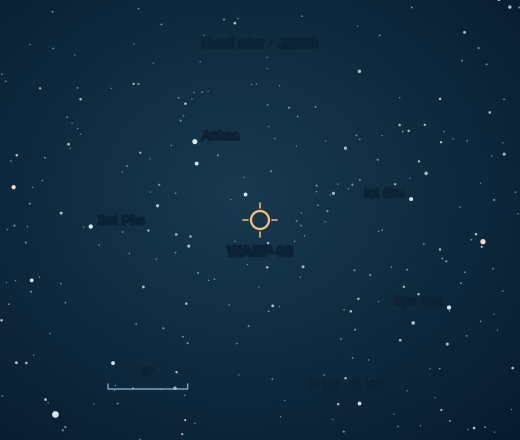
    On the north-up chart, start at Ankaa. The target lies about 6.4° southwest of it. Match the surrounding stars before changing magnification. The point to identify is WASP-96, listed at visual magnitude 12.6.

  3. Record the dip

    Obtain a current transit prediction for WASP-96 at your West Coast site. Record the host and comparison stars before, during and after the event. Look for a change of about 1.38%.

A closer look at WASP-96 b

One of Webb’s earliest public exoplanet spectra came from WASP-96 b. The transit revealed how strongly its atmosphere absorbed different near-infrared wavelengths.

The catalogue gives an orbital period of 3.43 days. A transit lasts about 2.4 hours and lowers the star’s measured light by roughly 1.4%. A stable comparison star helps separate that dip from changes in the sky.

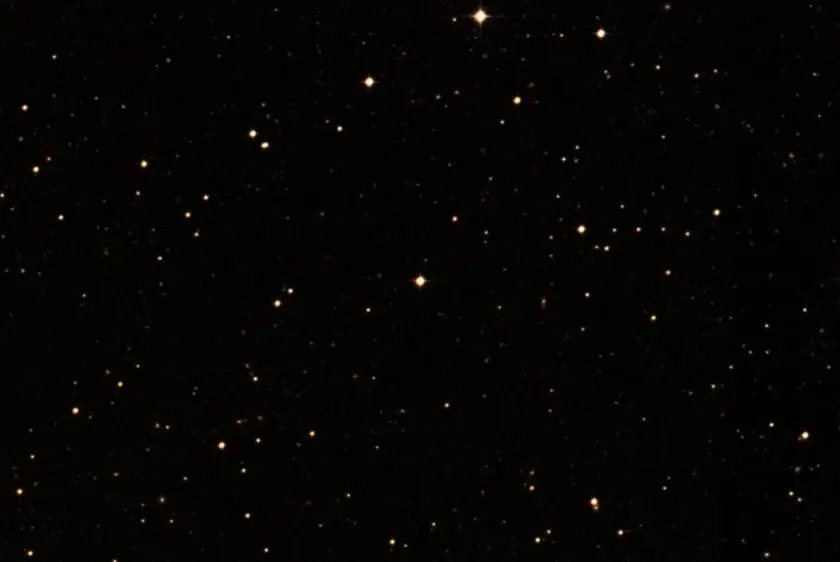
The plotted spectrum is built from many light curves in narrow bands. The star-field photograph shows where the observation was made.