

LIBRE TELESCOPE
Menu
Book Event

Sky Guide

WASP-39 b

Quick Stats

Name:
WASP-39 b
Type:
Object
Observability:
Difficult
Best telescope for viewing:
Tracking telescope and calibrated astronomy camera for transit photometry. Use a comparison star in the same field.

How to view WASP-39 b

  1. Plan around meridian passage

    Try June 2–6, 2027. At its highest the field is about 53° above the horizon in Los Angeles and 39° in Seattle. Use your city’s meridian time for the best view.

  2. Identify the host star

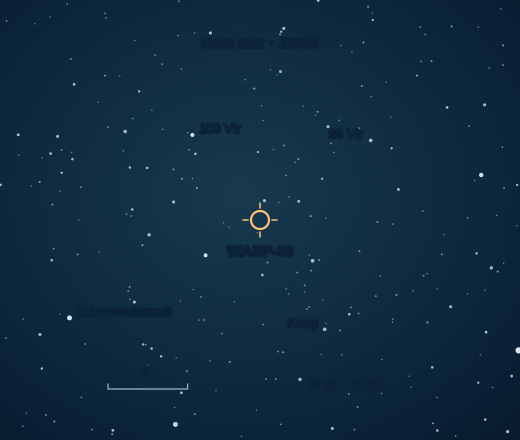
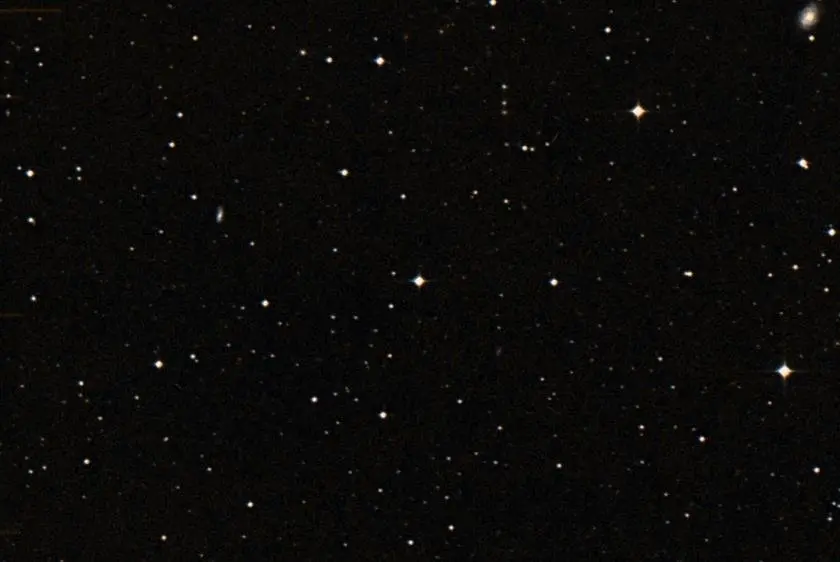
    On the north-up chart, start at Zubeneschamali. The target lies about 13.2° northwest of it. Match the surrounding stars before changing magnification. The point to identify is WASP-39, listed at visual magnitude 12.1.

  3. Record the dip

    Obtain a current transit prediction for WASP-39 at your West Coast site. Record the host and comparison stars before, during and after the event. Look for a change of about 2.34348%.

A closer look at WASP-39 b

This inflated giant became a benchmark for Webb transmission spectroscopy. Its atmosphere produced a distinct carbon dioxide signal, among other features, in filtered starlight.

The catalogue gives an orbital period of 4.06 days. A transit lasts about 2.8 hours and lowers the star’s measured light by roughly 2.3%. A stable comparison star helps separate that dip from changes in the sky.

The planet’s apparent size varies slightly with wavelength as gases absorb different colors. A broadband transit measures the much larger overall dip.