

LIBRE TELESCOPE
Menu
Book Event

Sky Guide

WASP-17 b

Quick Stats

Name:
WASP-17 b
Type:
Object
Observability:
Difficult
Best telescope for viewing:
Tracking telescope and calibrated astronomy camera for transit photometry. Use a comparison star in the same field.

How to view WASP-17 b

  1. Plan around meridian passage

    Try July 2–6, 2027. At its highest the field is about 28° above the horizon in Los Angeles and 14° in Seattle. Use your city’s meridian time for the best view.

  2. Identify the host star

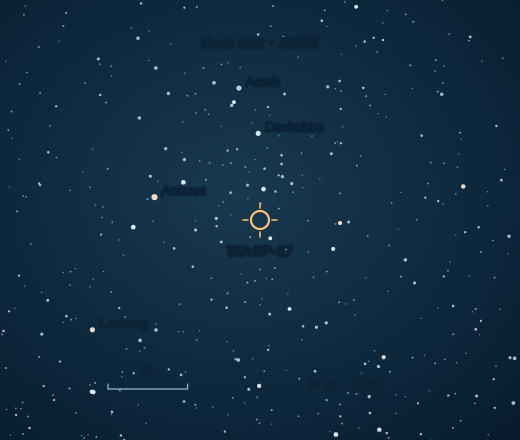
    On the north-up chart, start at Fang. The target lies about 2.0° south of it. Match the surrounding stars before changing magnification. The point to identify is WASP-17, listed at visual magnitude 11.6.

  3. Record the dip

    Obtain a current transit prediction for WASP-17 at your West Coast site. Record the host and comparison stars before, during and after the event. Look for a change of about 1.7%.

A closer look at WASP-17 b

WASP-17 b is a remarkably inflated giant planet. Its large silhouette makes it a useful target for measurements of starlight filtered through the planet’s atmosphere.

The catalogue gives an orbital period of 3.74 days. A transit lasts about 4.4 hours and lowers the star’s measured light by roughly 1.7%. A stable comparison star helps separate that dip from changes in the sky.

The transit gives the planet’s size relative to its star. Its low density becomes apparent only after adding a mass measurement. On a wide-field chart, Alniyat lies about 5.4° from this target. Observations of exoplanets often measure changes in the host star’s light.