

LIBRE TELESCOPE
Menu
Book Event

Sky Guide

Venus at greatest western elongation

Quick Stats

Name:
Venus at greatest western elongation
Type:
Event
Observability:
Naked eye
Rarity:
Common · About 584 days between morning maxima
Date of last occurrence:
Jun 1, 2025
Date of next occurrence:
Jan 3, 2027
Date of occurrence after that:
Aug 10, 2028
Best telescope for viewing:
Find the planet by eye in twilight, with the Sun below the horizon.

Maximum angular separation · UT · Calendar reference: November 28, 2026.

How to view Venus at greatest western elongation

  1. Choose the twilight window

    Mornings around January 3, 2027. Check the sunrise time at your West Coast site and pick an unobstructed eastern horizon.

  2. Find the planet by eye

    Use a dated local chart to estimate the height of Venus in twilight. Finish any optical observing before sunrise.

  3. Follow the apparition

    Revisit the same spot over several clear days and record the planet’s height at similar twilight brightness. The highest local altitude need not coincide exactly with greatest elongation.

A closer look at Venus at greatest western elongation

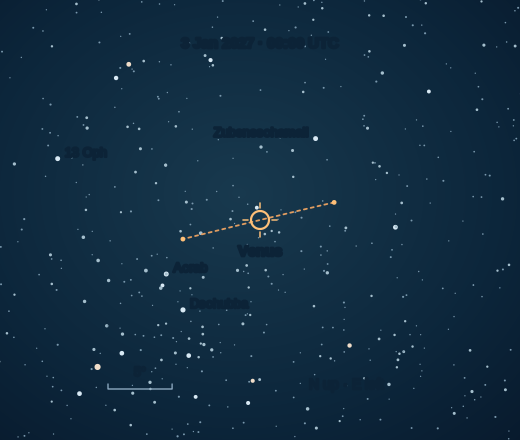
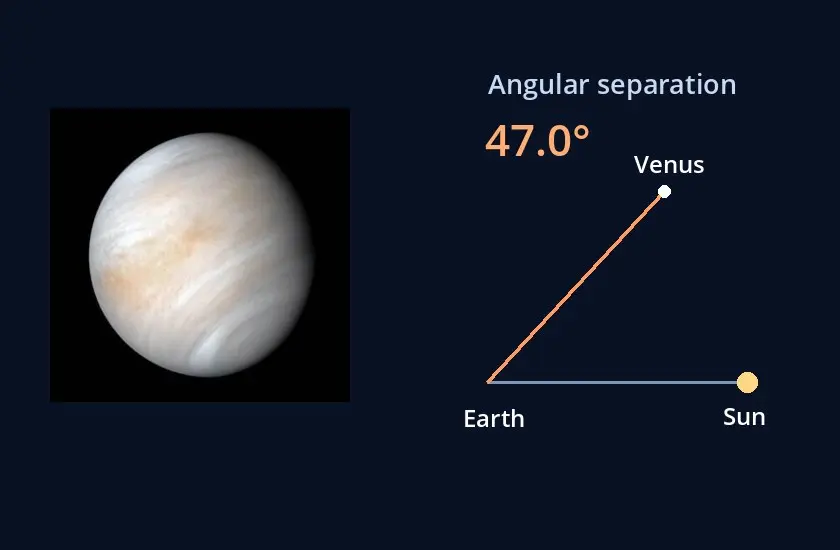
At greatest western elongation Venus lies far west of the Sun in our sky. Earth’s rotation brings it above the eastern horizon before sunrise, giving observers a morning viewing window.

On January 3, 2027, the separation reaches about 47 degrees. The planet is near half phase around elongation, although the date its disk looks exactly half lit can differ from the geometric prediction.

Find Venus by eye before dawn and sketch its phase through a telescope while the Sun is still below the horizon. The changing angle of the ecliptic alters its local height from one latitude to another.

Want to learn more about Venus at greatest western elongation? Elongation (astronomy) on Wikipedia.