

LIBRE TELESCOPE
Menu
Book Event

Sky Guide

Venus at greatest eastern elongation

Quick Stats

Name:
Venus at greatest eastern elongation
Type:
Event
Observability:
Naked eye
Rarity:
Common · About 584 days between evening elongations
Date of last occurrence:
Aug 15, 2026
Date of next occurrence:
Mar 22, 2028
Date of occurrence after that:
Oct 27, 2029
Best telescope for viewing:
Find the planet by eye in twilight, with the Sun below the horizon.

Maximum angular separation · UT · Calendar reference: November 28, 2026.

How to view Venus at greatest eastern elongation

  1. Choose the twilight window

    Evenings around March 22, 2028. Check the sunset time at your West Coast site and pick an unobstructed western horizon.

  2. Find the planet by eye

    Use a dated local chart to estimate the height of Venus in twilight. Wait until the Sun has fully set before using any optical instrument.

  3. Follow the apparition

    Revisit the same spot over several clear days and record the planet’s height at similar twilight brightness. The highest local altitude need not coincide exactly with greatest elongation.

A closer look at Venus at greatest eastern elongation

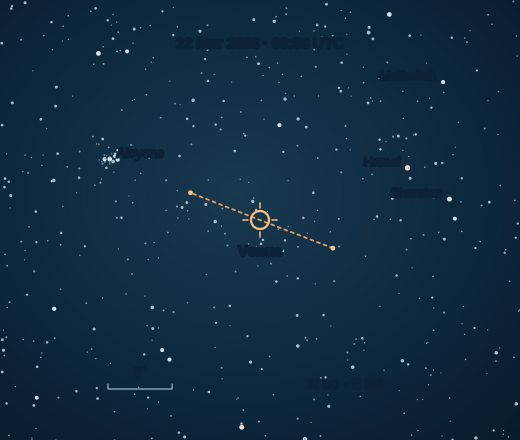
When Venus reaches its greatest eastern elongation, it stands farthest east of the Sun for that evening appearance. Earth’s rotation carries the Sun below the horizon first, leaving Venus in the western sky.

The March 2028 separation is about 46 degrees. Near elongation, a telescope usually shows a disk close to half illuminated, tying the planet’s phase to its place in orbit.

Wait until after sunset before using optical equipment. Sketch the phase and repeat several weeks later, when Venus’s apparent size and the lit fraction of its disk will have changed.

Want to learn more about Venus at greatest eastern elongation? Elongation (astronomy) on Wikipedia.