

LIBRE TELESCOPE
Menu
Book Event

Sky Guide

TRAPPIST-1 e

Quick Stats

Name:
TRAPPIST-1 e
Type:
Object
Observability:
Expert
Best telescope for viewing:
Research-grade time-series photometry for the transit. Use an archived light curve or an observatory with a suitable precision camera.

How to view TRAPPIST-1 e

  1. Plan around meridian passage

    Try September 28–October 2, 2027. At its highest the field is about 51° above the horizon in Los Angeles and 37° in Seattle. Use your city’s meridian time for the best view.

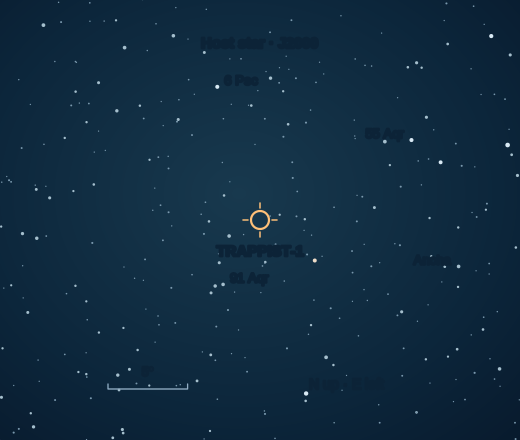
  2. Identify the host star

    On the north-up chart, start at Skat. The target lies about 11.2° north of it. Match the surrounding stars before changing magnification. The point to identify is TRAPPIST-1, listed at visual magnitude 17.0.

  3. Inspect the transit light curve

    Open the archived observations of this host. Normalize the brightness outside transit and compare repeated dips at the published orbital period.

A closer look at TRAPPIST-1 e

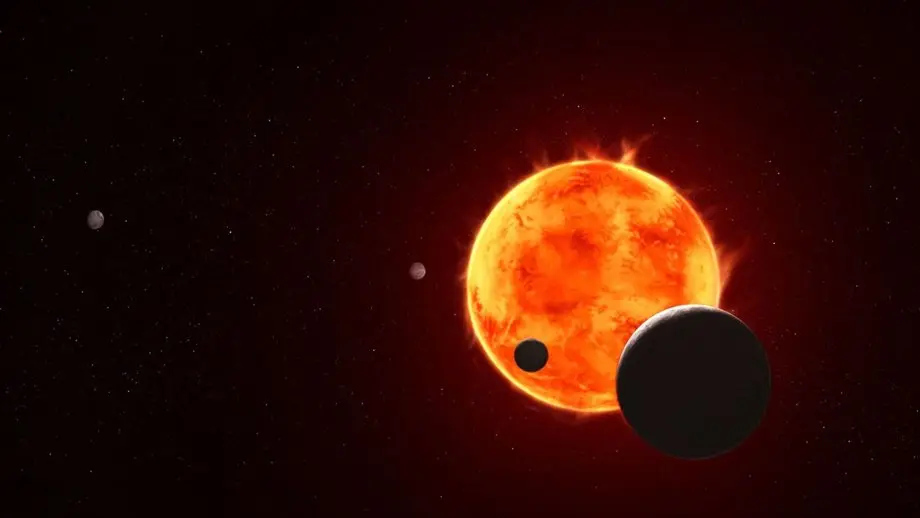
TRAPPIST-1 e is one of seven roughly Earth-sized planets known to transit an ultracool dwarf. Their repeated crossings form an intricate pattern of dips in one small star’s light.

The catalogue gives an orbital period of 6.1 days. A transit lasts about 0.93 hours and lowers the star’s measured light by roughly 0.5%. A stable comparison star helps separate that dip from changes in the sky.

The planets tug on one another, shifting their transit times and revealing their masses. Webb also measures planet e’s transit at different wavelengths to look for an atmosphere, a much subtler signal than the overall dip. On a wide-field chart, NGC 7541 in Pisces lies about 9.8° from this target. Observations of exoplanets often measure changes in the host star’s light.