

LIBRE TELESCOPE
Menu
Book Event

Sky Guide

Small Magellanic Cloud

Quick Stats

Name:
Small Magellanic Cloud
Type:
Object
Observability:
Naked eye
Best telescope for viewing:
Celestron Cometron 7×50 binoculars — for the star clouds and overall outline from a southern latitude.

How to view Small Magellanic Cloud

  1. Choose a southern observing site

    At declination 72.8° south this field stays below the horizon across the contiguous U.S. West Coast. Use a southern observatory’s images or observe through a remote telescope farther south.

  2. Find the field

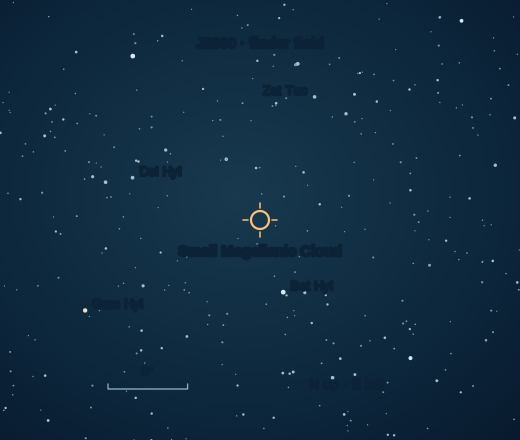
    On the north-up chart, start at Achernar. The target lies about 16.2° south of it. Match the surrounding stars before changing magnification.

  3. Check the identification

    From a southern site, outline the cloud by eye. Scan across it in binoculars and compare the bright stellar patches with the darker surroundings.

Best telescope for viewing Small Magellanic Cloud: Celestron Cometron 7×50 binoculars — for the star clouds and overall outline from a southern latitude. on Amazon

A closer look at Small Magellanic Cloud

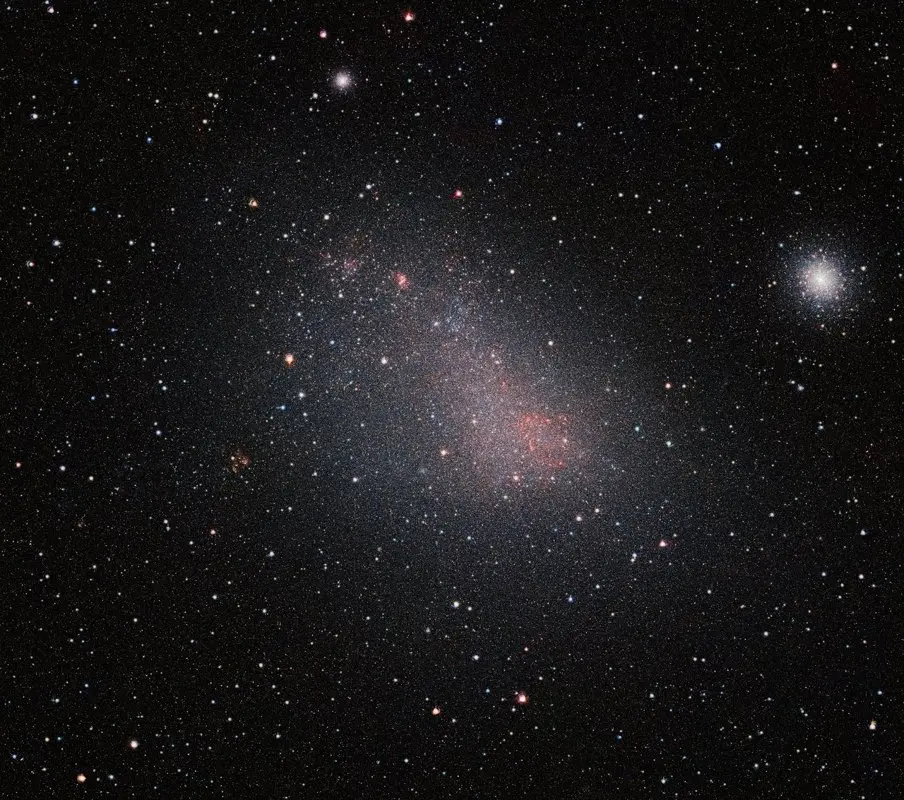
The smaller of the two prominent Magellanic Clouds is another nearby galaxy. Under a dark southern sky it is a soft, extended patch in Tucana.

Infrared surveys reveal rich star fields in parts of the galaxy where dust complicates visible-light observations.

Look for the bright globular cluster 47 Tucanae nearby. The two appear side by side from Earth, but the cluster is a much nearer member of the Milky Way.

Want to learn more about Small Magellanic Cloud? Small Magellanic Cloud on Wikipedia.