

LIBRE TELESCOPE
Menu
Book Event

Sky Guide

The Ring Nebula

M57

Quick Stats

Name:
The Ring Nebula (M57)
Type:
Object
Observability:
Intermediate
Best telescope for viewing:
Sky-Watcher Classic 200P 8-inch Dobsonian — to distinguish the bright annulus from its darker center.

How to view M57

  1. Plan around meridian passage

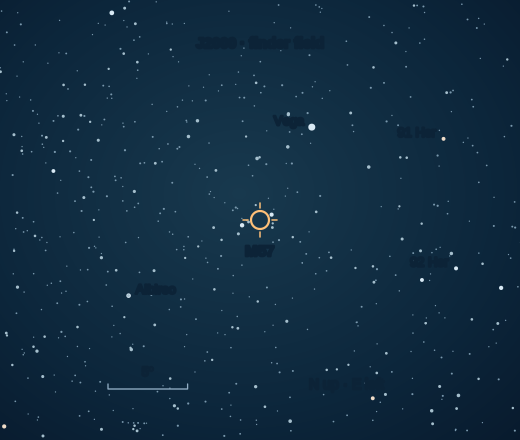
    Try July 31–August 4, 2027. At its highest the field is about 89° above the horizon in Los Angeles and 75° in Seattle. Use your city’s meridian time for the best view.

  2. Start in Lyra

    Find Vega and the small parallelogram of Lyra. Move along the line between Sheliak and Sulafat to search for the small ring.

  3. Check the identification

    Increase magnification until the tiny disk is clearly larger than a nearby star. Check whether the middle looks dimmer than the rim.

Best telescope for viewing M57: Sky-Watcher Classic 200P 8-inch Dobsonian — to distinguish the bright annulus from its darker center. on Amazon

A closer look at M57

On a summer evening, find Vega and the little parallelogram of stars beside it in Lyra. Between the two stars farthest from Vega sits a pale oval. Through a telescope at moderate magnification, its center looks dimmer than its rim. It resembles a tiny smoke ring suspended among sharp points of starlight.

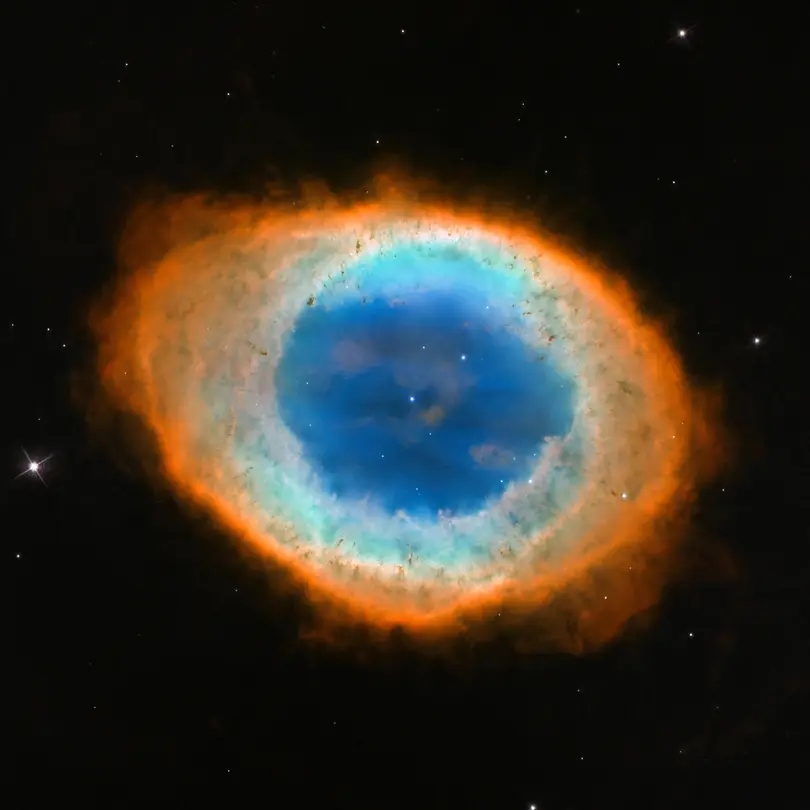
The gas once belonged to a star much like the Sun. Late in life, that star shed its outer layers and exposed its hot core. Ultraviolet light from the core makes the expelled gas glow. Astronomers call this kind of object a planetary nebula, a name inherited from its appearance in early telescopes.

The hole is a trick of perspective. Hubble helped reveal a football-shaped volume of gas extending toward us and away from us, with a thicker belt around its middle. In the photograph, the blue center looks straight down the long axis. The bright oval at the eyepiece is the belt seen almost end-on.

Want to learn more about the Ring Nebula? Ring Nebula on Wikipedia.