

LIBRE TELESCOPE
Menu
Book Event

Sky Guide

PDS 70 b

Quick Stats

Name:
PDS 70 b
Type:
Object
Observability:
Expert
Best telescope for viewing:
University-class adaptive-optics telescope with high-contrast imaging to separate the planet from its host.

How to view PDS 70 b

  1. Catch the field at its highest

    From Los Angeles this field peaks 15° high. From Seattle it is less than 1° high. For June 2–6, 2027, check the local time of meridian passage and choose an unobstructed southern horizon.

  2. Identify the host star

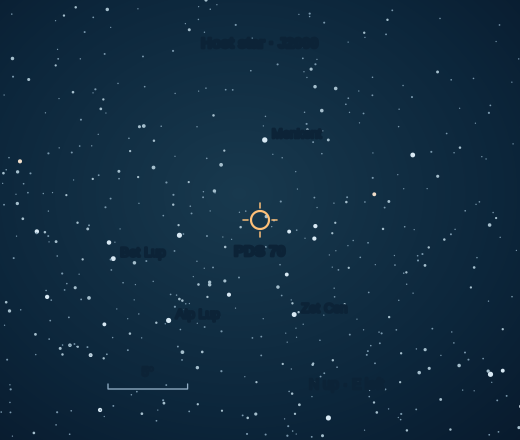
    On the north-up chart, start at Menkent. The target lies about 5.0° south of it. Match the surrounding stars before changing magnification. The point to identify is PDS 70, listed at visual magnitude 12.0.

  3. Read the high-contrast image

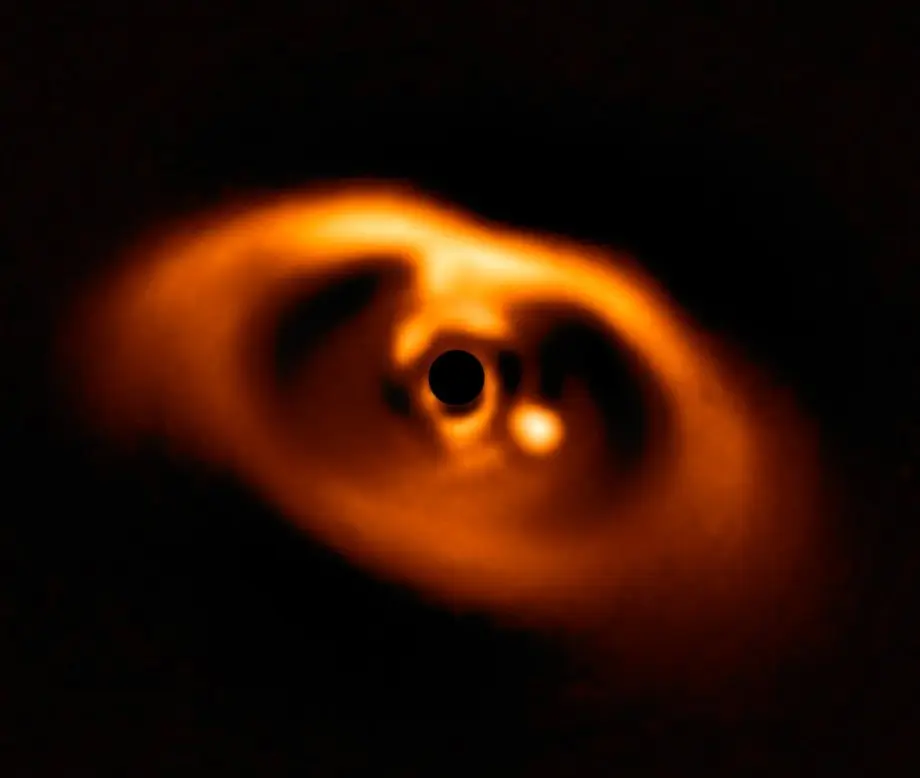
    Use the instrument’s orientation arrow and angular scale to locate the companion in the published image. The stellar glare is suppressed during that observation.

A closer look at PDS 70 b

PDS 70 b was imaged growing inside a gap in a young star’s disk. It gives astronomers a chance to observe a giant planet while material for planet formation is still present.

The system is about 369 light-years away, and the catalogue gives an orbital period of roughly 119 years. The host has visual magnitude 12.03, which sets the scale of the starlight an observer must contend with.

Locate the small bright point within the disk image. Isolating it required a large telescope and an instrument designed to suppress the central star.