


LIBRE TELESCOPE
Menu
Book Event

Sky Guide

The Omicron Velorum Cluster

IC 2391

Quick Stats

Name:
The Omicron Velorum Cluster (IC 2391)
Type:
Object
Observability:
Naked eye
Best telescope for viewing:
Celestron Cometron 7×50 binoculars — for a field wide enough to include the main group and outlying stars.

How to view IC 2391

  1. Check the southern horizon

    At its highest this field is 4° high from San Diego and below the horizon from Seattle. A site farther south gives a clearer view. At coastal latitudes, terrain and haze can conceal it even when it rises.

  2. Find the field

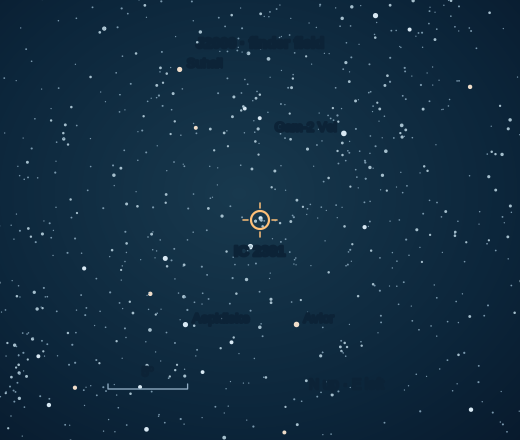
    On the north-up chart, start at Alsephina. The target lies about 1.8° north of it. Match the surrounding stars before changing magnification.

  3. Check the identification

    The catalogued long axis is 29.1 arcminutes. Keep a few field stars beyond the cluster in the eyepiece. Compare the density in the middle with the density near the edge.

Best telescope for viewing IC 2391: Celestron Cometron 7×50 binoculars — for a field wide enough to include the main group and outlying stars. on Amazon

A closer look at IC 2391

The Omicron Velorum Cluster is close enough for its brighter stars to scatter over an appreciable piece of sky. Begin with binoculars and use the named star to anchor the pattern.

Astronomers can separate travelers moving with the cluster from stars merely crossing its field. The Gaia-based census lists 222 high-probability members and estimates an age of 29 million years at about 480 light-years.

Mark Alsephina in the finder. A sweep of about 1.8° north brings the catalogue position into the field. Keep a few outlying stars in the field when sketching the group, so its scale is preserved.

Want to learn more about the Omicron Velorum Cluster? IC 2391 on Wikipedia.