


LIBRE TELESCOPE
Menu
Book Event

Sky Guide

NGC 2336 in Camelopardalis

Quick Stats

Name:
NGC 2336 in Camelopardalis
Type:
Object
Observability:
Intermediate
Best telescope for viewing:
Sky-Watcher Classic 200P 8-inch Dobsonian — to distinguish the galaxy’s central brightness and apparent shape under a dark sky.

How to view NGC 2336 in Camelopardalis

  1. Plan around meridian passage

    Try February 4–8, 2027. At its highest the field is about 44° above the horizon in Los Angeles and 57° in Seattle. Use your city’s meridian time for the best view.

  2. Find the field

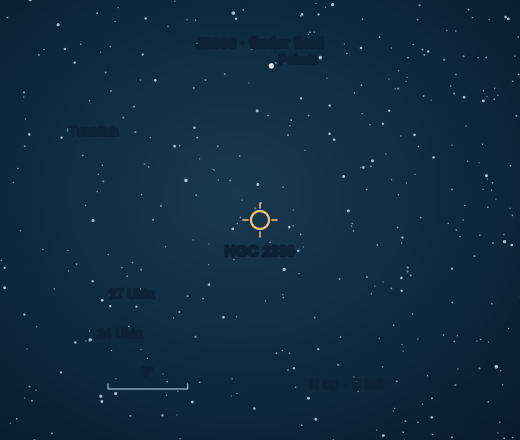
    On the north-up chart, start at Polaris. The target lies about 9.6° east of it. Match the surrounding stars before changing magnification.

  3. Check the identification

    The catalogued long axis is 5.01 arcminutes. Center the brighter core, then sketch which side of the elongated light is easiest to follow with averted vision.

Best telescope for viewing NGC 2336 in Camelopardalis: Sky-Watcher Classic 200P 8-inch Dobsonian — to distinguish the galaxy’s central brightness and apparent shape under a dark sky. on Amazon

A closer look at NGC 2336 in Camelopardalis

NGC 2336 has long spiral arms dotted with blue stars and a relatively warm-colored central region. The contrasting colors trace different populations across one large galaxy.

OpenNGC lists NGC 2336 at 5.0′ by 2.8′. The total visual magnitude is about 10.7. A slightly brighter background can erase the outer light before the center disappears.

Mark Polaris in the finder. A sweep of about 9.6° east brings the catalogue position into the field. A dark-adapted side glance helps separate the center from the fainter disk.

Want to learn more about NGC 2336 in Camelopardalis? NGC 2336 on Wikipedia.