

A closer look at NGC 1569 in Camelopardalis
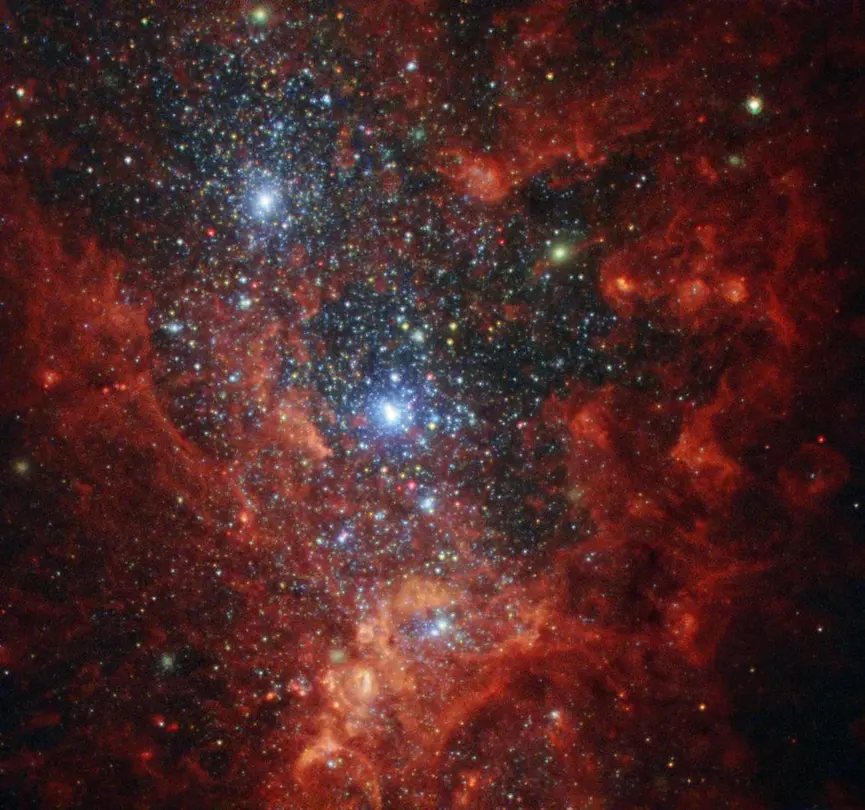
A burst of star formation created conspicuous massive clusters in this dwarf. Winds and supernova explosions have driven glowing material outward beyond its brightest regions.
Compare the compact clusters with the irregular surrounding gas. The high-energy output of a small galaxy can reshape a much larger volume.
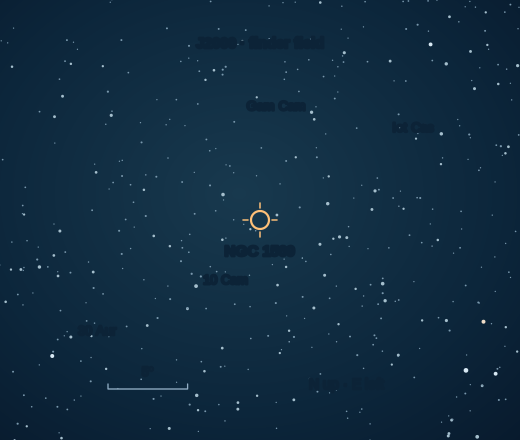
Use Miram to orient your finder. The target is about 15.1° to its northeast on the celestial sphere. The catalogue gives an apparent size of 3.9′ × 2.2′. On a wide-field chart, NGC 1502 in Camelopardalis lies about 3.6° from this target.
Want to learn more about NGC 1569 in Camelopardalis? NGC 1569 on Wikipedia.