

LIBRE TELESCOPE
Menu
Book Event

Sky Guide

NGC 1528 in Perseus

Quick Stats

Name:
NGC 1528 in Perseus
Type:
Object
Observability:
Easy
Best telescope for viewing:
Sky-Watcher Heritage 130P tabletop reflector — to resolve the brighter members in the same field as the cluster’s outline.

How to view NGC 1528 in Perseus

  1. Plan around meridian passage

    Try December 7–11, 2026. At its highest the field is about 73° above the horizon in Los Angeles and 86° in Seattle. Use your city’s meridian time for the best view.

  2. Find the field

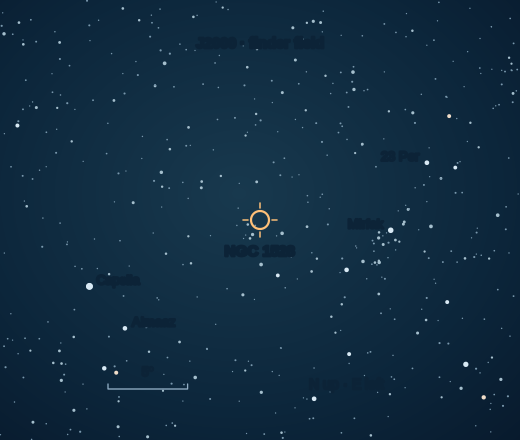
    On the north-up chart, start at Mirfak. The target lies about 8.2° east of it. Match the surrounding stars before changing magnification.

  3. Check the identification

    The catalogued long axis is 9.6 arcminutes. Keep a few field stars beyond the cluster in the eyepiece. Compare the density in the middle with the density near the edge.

Best telescope for viewing NGC 1528 in Perseus: Sky-Watcher Heritage 130P tabletop reflector — to resolve the brighter members in the same field as the cluster’s outline. on Amazon

A closer look at NGC 1528 in Perseus

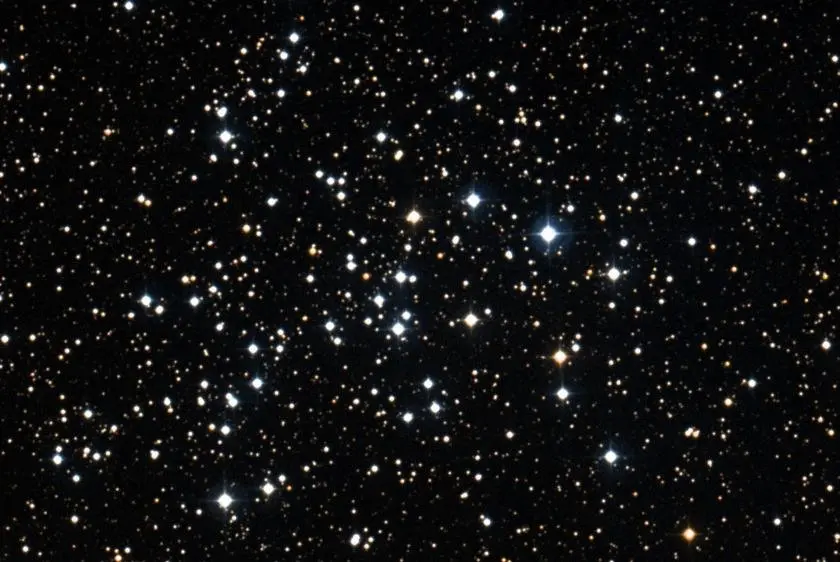
NGC 1528 is an inviting Perseus cluster for a low-power eyepiece. Compare it with NGC 1545 in the same part of the sky and notice how differently their brightest stars are arranged.

Astronomers can separate travelers moving with the cluster from stars merely crossing its field. The Gaia-based census lists 306 high-probability members and estimates an age of 295 million years at about 3,480 light-years.

Mark Mirfak in the finder. A sweep of about 8.2° east brings the catalogue position into the field. Keep a few outlying stars in the field when sketching the group, so its scale is preserved.