

LIBRE TELESCOPE
Menu
Book Event

Sky Guide

M77 in Cetus

NGC 1068

Quick Stats

Name:
M77 in Cetus (NGC 1068)
Type:
Object
Observability:
Intermediate
Best telescope for viewing:
Sky-Watcher Classic 200P 8-inch Dobsonian — to distinguish the galaxy’s central brightness and apparent shape under a dark sky.

How to view NGC 1068

  1. Plan around meridian passage

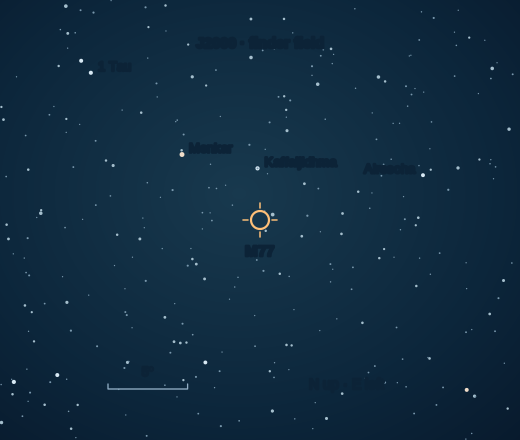
    Try December 7–11, 2026. At its highest the field is about 56° above the horizon in Los Angeles and 42° in Seattle. Use your city’s meridian time for the best view.

  2. Find the field

    On the north-up chart, start at Menkar. The target lies about 6.4° southwest of it. Match the surrounding stars before changing magnification.

  3. Check the identification

    The catalogued long axis is 6.11 arcminutes. Compare the central light with the field just outside it. Sketch the edge you can repeatedly recover with a side glance.

Best telescope for viewing NGC 1068: Sky-Watcher Classic 200P 8-inch Dobsonian — to distinguish the galaxy’s central brightness and apparent shape under a dark sky. on Amazon

A closer look at NGC 1068

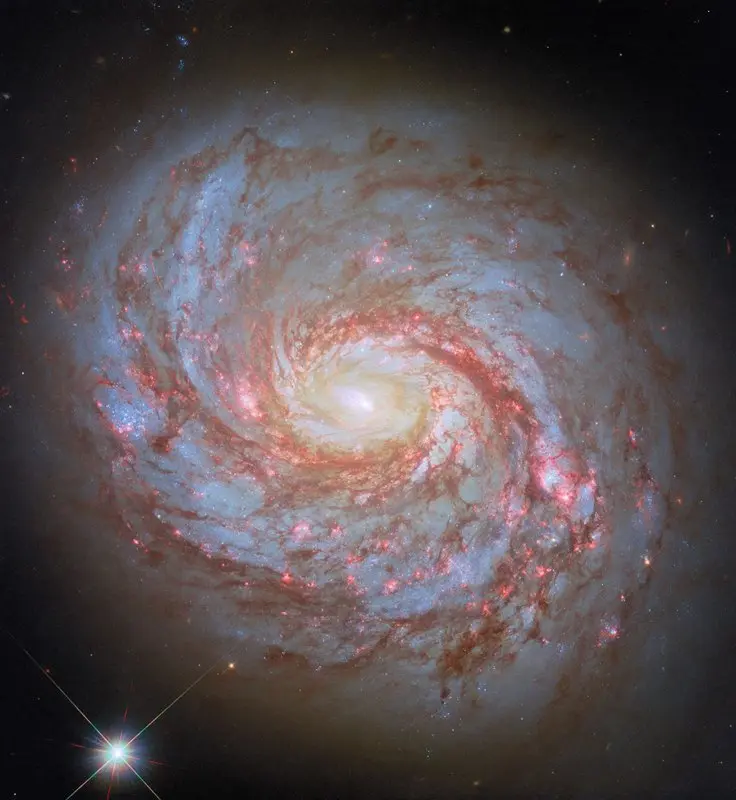
M77 is an active spiral galaxy in Cetus. Its bright inner region helped early observers detect it long before they knew it was another galaxy.

A supermassive black hole powers the active nucleus. Observations at different wavelengths probe material concealed by dust.

Look for a concentrated glow in the correct star field. The activity that supplies its central engine is a story told by spectra and multiwavelength images. On a wide-field chart, NGC 1032 in Cetus lies about 1.4° from this target.

Want to learn more about M77 in Cetus? Messier 77 on Wikipedia.