

LIBRE TELESCOPE
Menu
Book Event

Sky Guide

Kepler-444 b

Quick Stats

Name:
Kepler-444 b
Type:
Object
Observability:
Expert
Best telescope for viewing:
Space-based photometry or equivalent research data for the very shallow transit. Use the published light curve.

How to view Kepler-444 b

  1. Plan around meridian passage

    Try July 31–August 4, 2027. At its highest the field is about 82° above the horizon in Los Angeles and 84° in Seattle. Use your city’s meridian time for the best view.

  2. Identify the host star

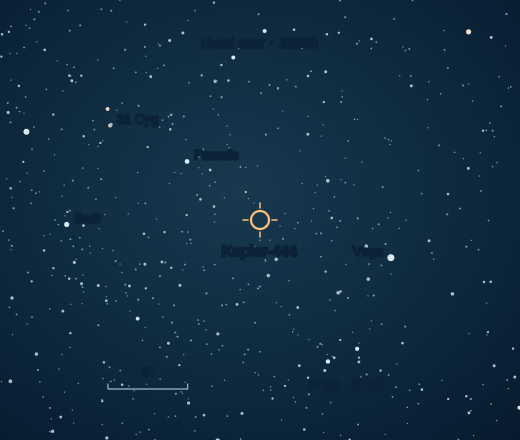
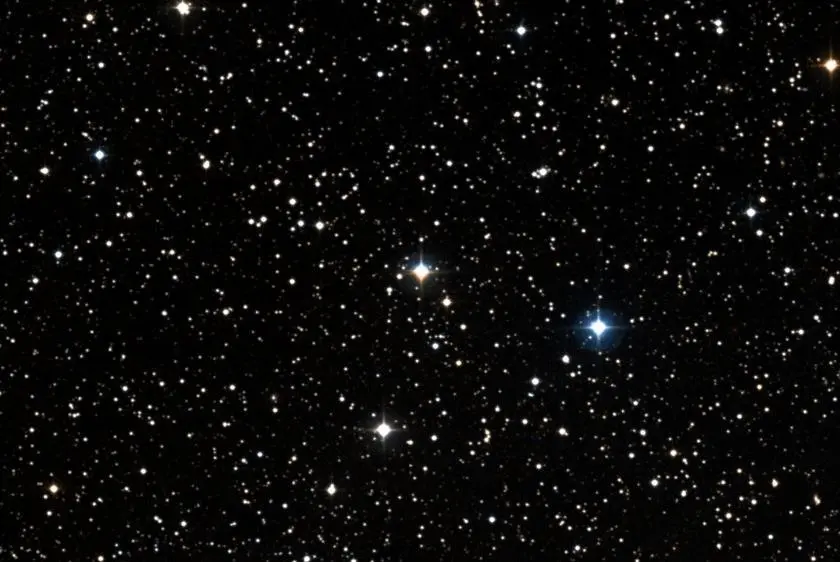
    On the north-up chart, start at Fawaris. The target lies about 5.9° southwest of it. Match the surrounding stars before changing magnification. The point to identify is Kepler-444, listed at visual magnitude 8.9.

  3. Inspect the transit light curve

    Open the archived observations of this host. Normalize the brightness outside transit and compare repeated dips at the published orbital period.

A closer look at Kepler-444 b

Five small planets orbit the old star Kepler-444, showing that rocky worlds could form early in our galaxy’s history. Planet b is the innermost member of the compact group.

The catalogue gives an orbital period of 3.6 days. A transit lasts about 2 hours and lowers the star’s measured light by roughly 0.0027%. A stable comparison star helps separate that dip from changes in the sky.

The tiny fractional change in light during a transit calls for spacecraft precision. The host is much easier to locate than the planet is to measure. On a wide-field chart, The Foxhead Cluster lies about 4.5° from this target. Observations of exoplanets often measure changes in the host star’s light.