

A closer look at Kepler-36 b
Kepler-36 b and its larger neighboring planet orbit surprisingly close together. Their appreciably different densities make the pair a natural experiment in what determines a planet’s composition.
The catalogue gives an orbital period of 13.9 days. A transit lasts about 7.3 hours and lowers the star’s measured light by roughly 0.0085%. A stable comparison star helps separate that dip from changes in the sky.
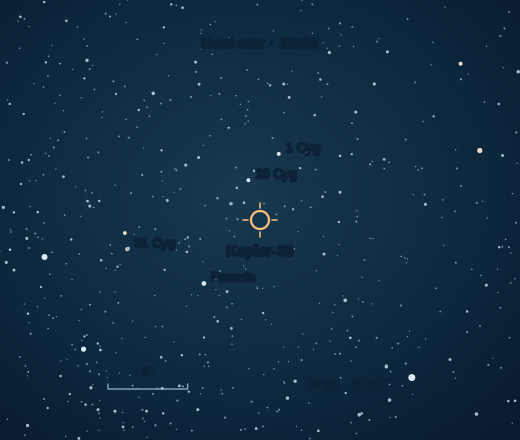
Their gravitational interaction shifts the times of transit. Those timing shifts helped astronomers weigh worlds too faint to image individually. On a wide-field chart, Blinking Planetary Nebula lies about 3.4° from this target. Observations of exoplanets often measure changes in the host star’s light.
NASA · planet archive · Host star on Wikipedia: Kepler-36 · Identifiers and catalog cross-references
Want to learn more about Kepler-36 b? Kepler-36b on Wikipedia.