

A closer look at Kepler-22 b
A long gap between transits initially made this planet a test of patience. Kepler had to observe multiple passages to establish its orbit around a star broadly similar to our Sun.
The catalogue gives an orbital period of 290 days. A transit lasts about 7.4 hours and lowers the star’s measured light by roughly 0.05%. A stable comparison star helps separate that dip from changes in the sky.
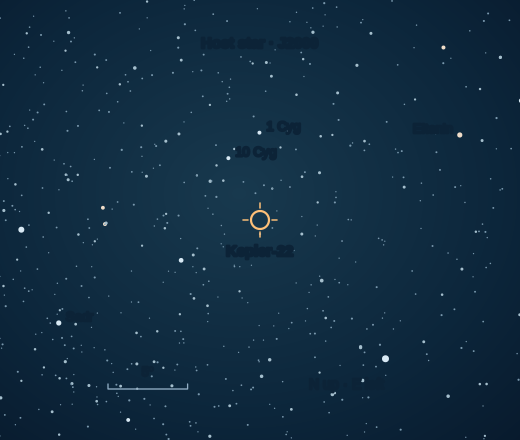
Its temperate orbit says something about received starlight. The measured radius alone leaves several possibilities for the planet’s interior and atmosphere. On a wide-field chart, Blinking Planetary Nebula lies about 5.3° from this target. Observations of exoplanets often measure changes in the host star’s light.
NASA · planet archive · Host star on Wikipedia: Kepler-22 · Identifiers and catalog cross-references
Want to learn more about Kepler-22 b? Kepler-22b on Wikipedia.