

A closer look at Kepler-10 b
Kepler-10 b was an early confirmed rocky planet from the Kepler mission. Its orbit hugs its star so tightly that the surface exposed to starlight experiences extreme heating.
The catalogue gives an orbital period of 0.837 days. A transit lasts about 1.8 hours and lowers the star’s measured light by roughly 0.019%. A stable comparison star helps separate that dip from changes in the sky.
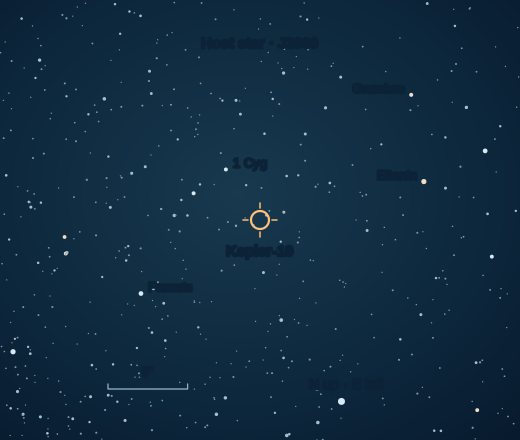
Transit measurements constrain size and stellar velocities constrain mass. Combining the two gives a bulk density that a photograph cannot reveal. On a wide-field chart, Blinking Planetary Nebula lies about 6.7° from this target. Observations of exoplanets often measure changes in the host star’s light.
NASA · planet archive · Host star on Wikipedia: Kepler-10 · Identifiers and catalog cross-references
Want to learn more about Kepler-10 b? Kepler-10b on Wikipedia.