

LIBRE TELESCOPE
Menu
Book Event

Sky Guide

KELT-9 b

Quick Stats

Name:
KELT-9 b
Type:
Object
Observability:
Difficult
Best telescope for viewing:
Tracking telescope and calibrated astronomy camera for transit photometry. Use a comparison star in the same field.

How to view KELT-9 b

  1. Plan around meridian passage

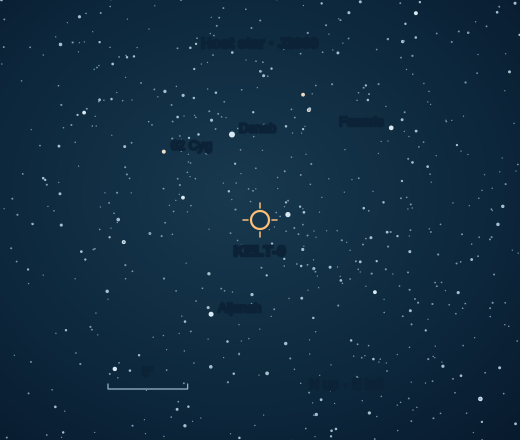
    Try August 29–September 2, 2027. At its highest the field is about 84° above the horizon in Los Angeles and 82° in Seattle. Use your city’s meridian time for the best view.

  2. Identify the host star

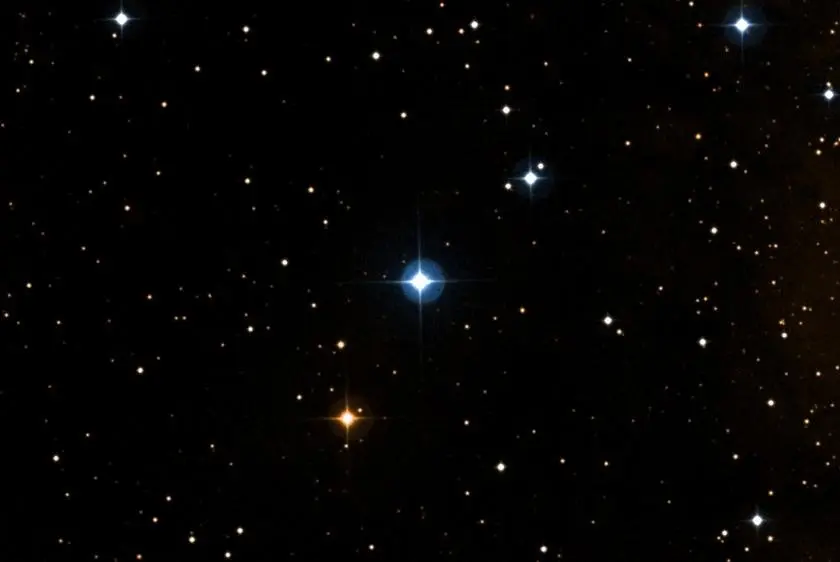
    On the north-up chart, start at Sadr. The target lies about 1.8° east of it. Match the surrounding stars before changing magnification. The point to identify is KELT-9, listed at visual magnitude 7.5.

  3. Record the dip

    Obtain a current transit prediction for KELT-9 at your West Coast site. Record the host and comparison stars before, during and after the event. Look for a change of about 0.678851%.

A closer look at KELT-9 b

KELT-9 b receives intense radiation from an exceptionally hot host star. Temperatures on the illuminated side rival those of some stars, making familiar planetary molecules less stable.

The catalogue gives an orbital period of 1.48 days. A transit lasts about 4.2 hours and lowers the star’s measured light by roughly 0.68%. A stable comparison star helps separate that dip from changes in the sky.

Different atomic species leave signatures in the spectrum. Those measurements probe conditions far removed from what a visible-light finder image suggests. On a wide-field chart, Sadr lies about 1.8° from this target. Observations of exoplanets often measure changes in the host star’s light.