

LIBRE TELESCOPE
Menu
Book Event

Sky Guide

The Jellyfish Nebula

IC 443

Quick Stats

Name:
The Jellyfish Nebula (IC 443)
Type:
Object
Observability:
Difficult
Best telescope for viewing:
Celestron StarSense Explorer DX 102AZ refractor — with a wide-field eyepiece for the extended cloud. A dark site is especially important.

How to view IC 443

  1. Plan around meridian passage

    Try January 5–9, 2027. At its highest the field is about 78° above the horizon in Los Angeles and 65° in Seattle. Use your city’s meridian time for the best view.

  2. Find the field

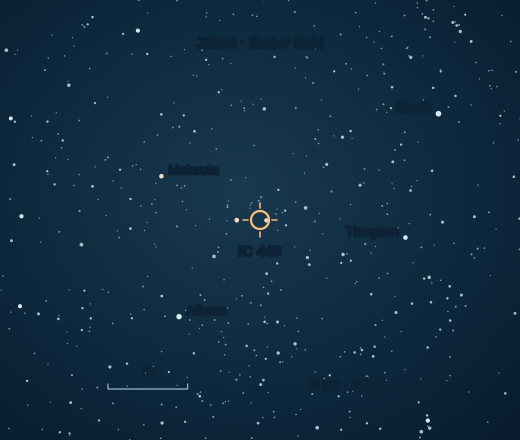
    On the north-up chart, start at Tejat. The target lies about 1.5° west of it. Match the surrounding stars before changing magnification.

  3. Check the identification

    The catalogued long axis is 50 arcminutes. Scan from the brightest patch into the adjacent sky, then reverse the sweep to check where the visible boundary falls.

Best telescope for viewing IC 443: Celestron StarSense Explorer DX 102AZ refractor — with a wide-field eyepiece for the extended cloud. A dark site is especially important. on Amazon

A closer look at IC 443

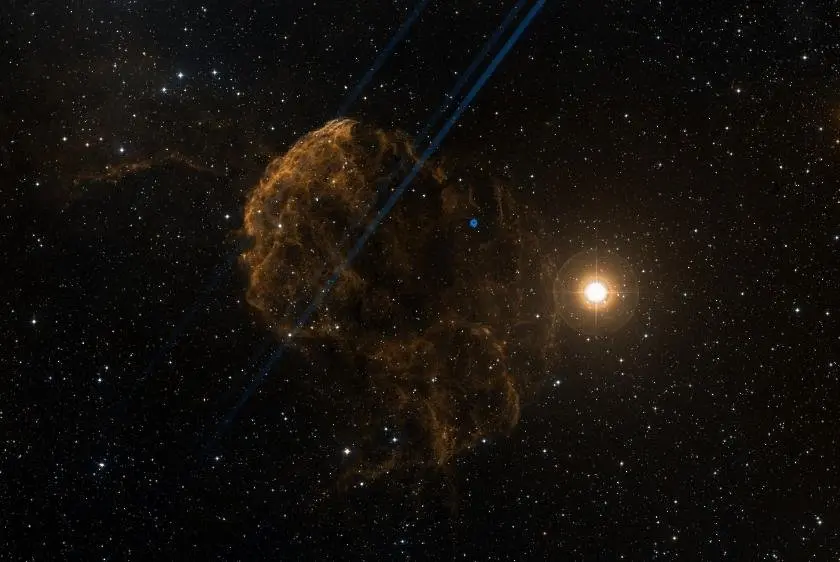
The Jellyfish is a supernova blast wave meeting material of different densities. Its bright ragged edges trace shocks, so the optical picture shows only selected parts of a much larger remnant.

OpenNGC lists IC 443 at 50.0′ by 40.0′. Compare the bright boundary with the adjacent sky. Changes in contrast across the field are often easier to detect than an isolated patch of faint glow.

The target is about 24 arcminutes east of Propus. Match the orientation of your eyepiece to the chart before starting the hop. Observe both on and just off the target to learn where the faint light ends.