

LIBRE TELESCOPE
Menu
Book Event

Sky Guide

IC 434 behind the Horsehead

Quick Stats

Name:
IC 434 behind the Horsehead
Type:
Object
Observability:
Difficult
Best telescope for viewing:
Celestron StarSense Explorer DX 102AZ refractor — with a wide-field eyepiece for the extended cloud. A dark site is especially important.

How to view IC 434 behind the Horsehead

  1. Plan around meridian passage

    Try January 5–9, 2027. At its highest the field is about 53° above the horizon in Los Angeles and 40° in Seattle. Use your city’s meridian time for the best view.

  2. Find the field

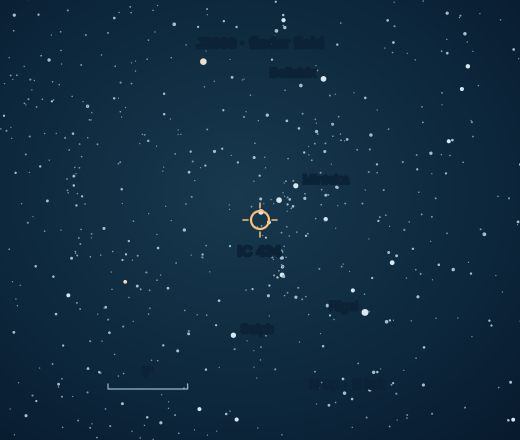
    On the north-up chart, start at Alnitak. The target lies about 31 arcminutes south of it. Match the surrounding stars before changing magnification.

  3. Check the identification

    The catalogued long axis is 90 arcminutes. Scan from the brightest patch into the adjacent sky, then reverse the sweep to check where the visible boundary falls.

Best telescope for viewing IC 434 behind the Horsehead: Celestron StarSense Explorer DX 102AZ refractor — with a wide-field eyepiece for the extended cloud. A dark site is especially important. on Amazon

A closer look at IC 434 behind the Horsehead

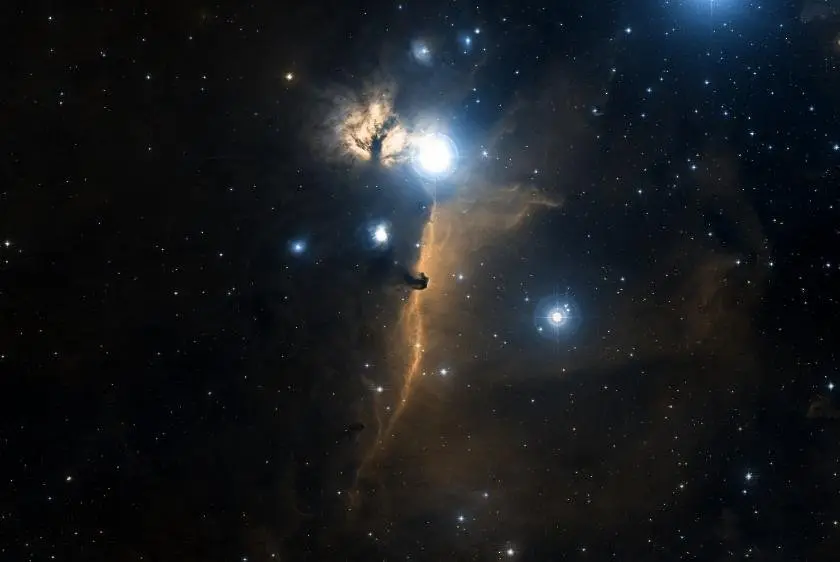
IC 434 provides the luminous background that makes the Horsehead visible. The horse-shaped notch is foreground dust cutting into a strip of glowing hydrogen south of Orion’s Belt.

OpenNGC lists IC 434 at 90.0′ by 30.0′. Compare the bright boundary with the adjacent sky. Changes in contrast across the field are often easier to detect than an isolated patch of faint glow.

Begin at Alnitak on a north-up chart and move about 0.5° south. Begin with binoculars or a wide-field image to keep the edges in context. On a wide-field chart, NGC 2023 in Orion lies about 15 arcminutes from this target.

Want to learn more about IC 434 behind the Horsehead? IC 434 on Wikipedia.