

LIBRE TELESCOPE
Menu
Book Event

Sky Guide

The IC 1284 emission nebula

Quick Stats

Name:
The IC 1284 emission nebula
Type:
Object
Observability:
Difficult
Best telescope for viewing:
Sky-Watcher Classic 250P 10-inch Dobsonian — for the faint bright–dark boundary under a transparent sky.

How to view The IC 1284 emission nebula

  1. Plan around meridian passage

    Try July 31–August 4, 2027. At its highest the field is about 36° above the horizon in Los Angeles and 23° in Seattle. Use your city’s meridian time for the best view.

  2. Find the field

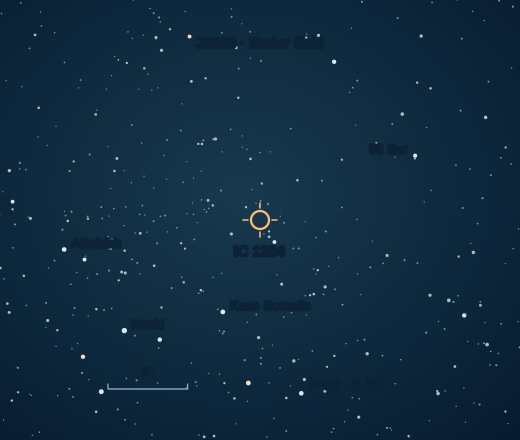
    On the north-up chart, start at Kaus Borealis. The target lies about 6.2° northwest of it. Match the surrounding stars before changing magnification.

  3. Check the identification

    The catalogued long axis is 16.98 arcminutes. Scan from the brightest patch into the adjacent sky, then reverse the sweep to check where the visible boundary falls.

Best telescope for viewing The IC 1284 emission nebula: Sky-Watcher Classic 250P 10-inch Dobsonian — for the faint bright–dark boundary under a transparent sky. on Amazon

A closer look at The IC 1284 emission nebula

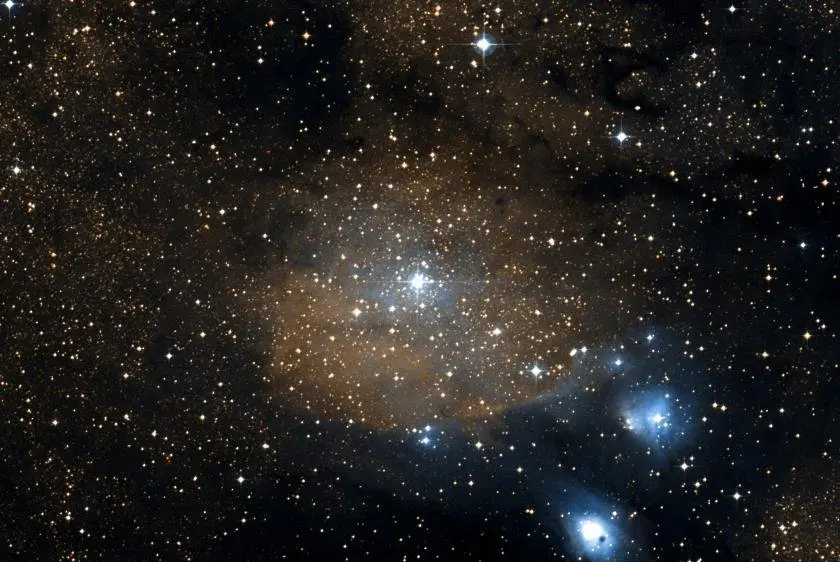
IC 1284 is an emission cloud in Sagittarius. The surrounding field contains reflection nebulosity as well, so a color exposure distinguishes regions that can look equally gray to the eye.

OpenNGC lists IC 1284 at 17.0′ by 15.1′. Compare the bright boundary with the adjacent sky. Changes in contrast across the field are often easier to detect than an isolated patch of faint glow.

Begin at Polis on a north-up chart and move about 1.7° northeast. Observe both on and just off the target to learn where the faint light ends. On a wide-field chart, NGC 6578 in Sagittarius lies about 51 arcminutes from this target. Use an eyepiece with a wide field of view to match the surrounding pattern of stars to the finder chart.

Want to learn more about the IC 1284 emission nebula? Sh 2-37 on Wikipedia.