

LIBRE TELESCOPE
Menu
Book Event

Sky Guide

HD 189733 b

Quick Stats

Name:
HD 189733 b
Type:
Object
Observability:
Difficult
Best telescope for viewing:
Tracking telescope and calibrated astronomy camera for transit photometry. Use a comparison star in the same field.

How to view HD 189733 b

  1. Plan around meridian passage

    Try August 29–September 2, 2027. At its highest the field is about 79° above the horizon in Los Angeles and 65° in Seattle. Use your city’s meridian time for the best view.

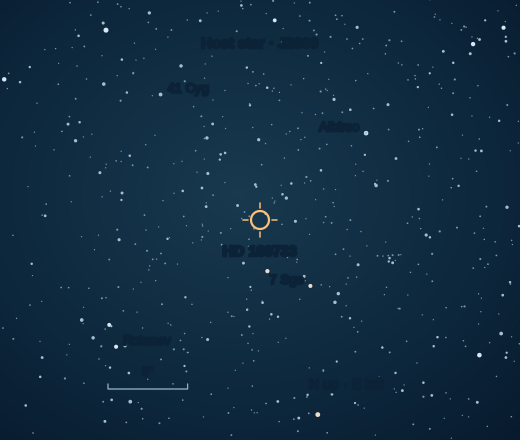
  2. Identify the host star

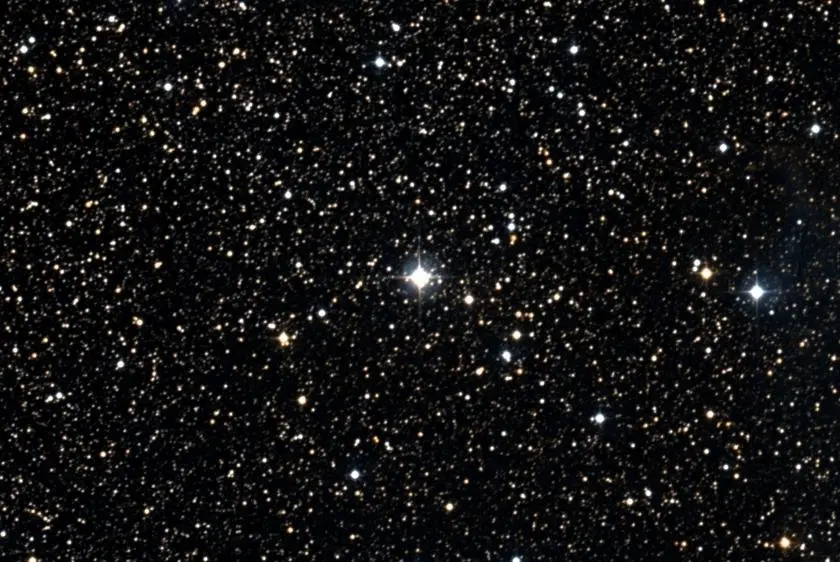
    On the north-up chart, start at Albireo. The target lies about 8.6° southeast of it. Match the surrounding stars before changing magnification. The point to identify is HD 189733, listed at visual magnitude 7.7.

  3. Record the dip

    Obtain a current transit prediction for HD 189733 at your West Coast site. Record the host and comparison stars before, during and after the event. Look for a change of about 2.4%.

A closer look at HD 189733 b

One of the best-studied hot Jupiters orbits a nearby orange star in Vulpecula. Its relatively deep transits make it a familiar target for experienced amateur photometrists.

The catalogue gives an orbital period of 2.22 days. A transit lasts about 1.8 hours and lowers the star’s measured light by roughly 2.4%. A stable comparison star helps separate that dip from changes in the sky.

The star lies near the Dumbbell Nebula on the sky. A chart that shows both makes a good bridge between traditional observing and measuring an exoplanet.