

LIBRE TELESCOPE
Menu
Book Event

Sky Guide

HD 17156 b

Quick Stats

Name:
HD 17156 b
Type:
Object
Observability:
Expert
Best telescope for viewing:
Research-grade time-series photometry for the transit. Use an archived light curve or an observatory with a suitable precision camera.

How to view HD 17156 b

  1. Plan around meridian passage

    Try November 26–30, 2027. At its highest the field is about 52° above the horizon in Los Angeles and 66° in Seattle. Use your city’s meridian time for the best view.

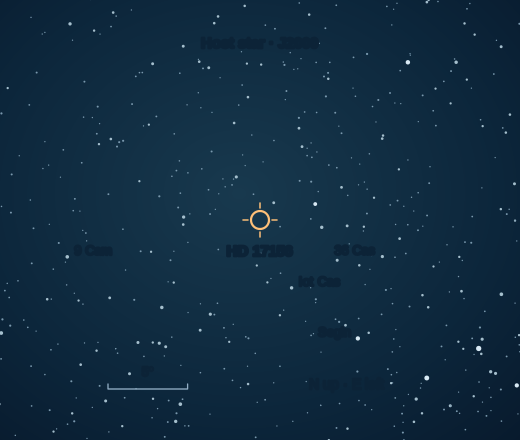
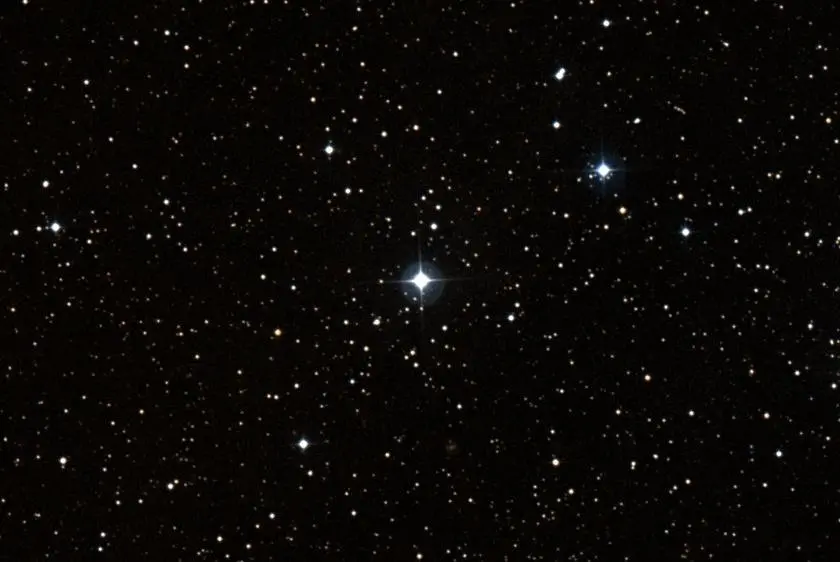
  2. Identify the host star

    On the north-up chart, start at Errai. The target lies about 13.4° east of it. Match the surrounding stars before changing magnification. The point to identify is HD 17156, listed at visual magnitude 8.2.

  3. Inspect the transit light curve

    Open the archived observations of this host. Normalize the brightness outside transit and compare repeated dips at the published orbital period.

A closer look at HD 17156 b

HD 17156 b combines a markedly eccentric orbit with observable transits. Its changing speed along the orbit illustrates how gravity affects a planet’s travel around a star.

The catalogue gives an orbital period of 21.2 days. A transit lasts about 3.2 hours and lowers the star’s measured light by roughly 0.55%. A stable comparison star helps separate that dip from changes in the sky.

Mid-transit times and stellar velocities constrain complementary parts of the orbit. The separation between consecutive transits is long enough to make planning important. On a wide-field chart, The Hidden Galaxy lies about 6.1° from this target. Observations of exoplanets often measure changes in the host star’s light.