

LIBRE TELESCOPE
Menu
Book Event

Sky Guide

GJ 1132 b

Quick Stats

Name:
GJ 1132 b
Type:
Object
Observability:
Expert
Best telescope for viewing:
Research-grade time-series photometry for the transit. Use an archived light curve or an observatory with a suitable precision camera.

How to view GJ 1132 b

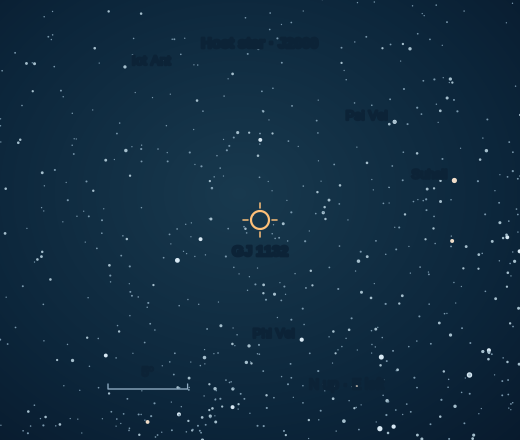
  1. Check the southern horizon

    At its highest this field is 10° high from San Diego and below the horizon from Seattle. A site farther south gives a clearer view. At coastal latitudes, terrain and haze can conceal it even when it rises.

  2. Identify the host star

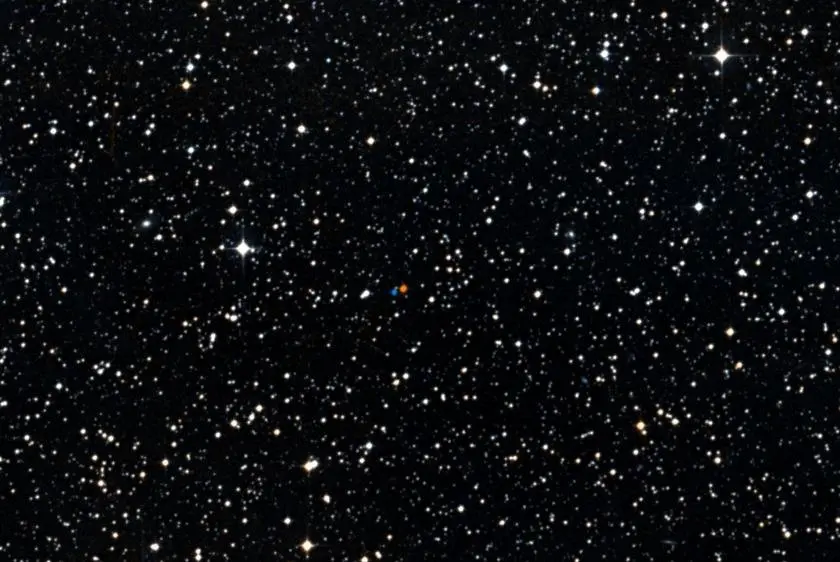
    On the north-up chart, start at Markeb. The target lies about 11.4° northeast of it. Match the surrounding stars before changing magnification. The point to identify is GJ 1132, listed at visual magnitude 13.7.

  3. Inspect the transit light curve

    Open the archived observations of this host. Normalize the brightness outside transit and compare repeated dips at the published orbital period.

A closer look at GJ 1132 b

A small planet in a short orbit repeatedly crosses this nearby red dwarf. The small host helps make a rocky planet’s transit easier to recognize than it would be across a Sun-sized star.

The catalogue gives an orbital period of 1.63 days. A transit lasts about 0.77 hours and lowers the star’s measured light by roughly 0.24%. A stable comparison star helps separate that dip from changes in the sky.

Studies of its atmosphere require careful treatment of the star as well as the planet. A transit light curve supplies the fundamental timing and size information.