


LIBRE TELESCOPE
Menu
Book Event

Sky Guide

Earth at perihelion

Quick Stats

Name:
Earth at perihelion
Type:
Event
Observability:
Difficult
Rarity:
Very common · Once each year, in early January
Date of last occurrence:
Jan 3, 2026
Date of next occurrence:
Jan 3, 2027
Date of occurrence after that:
Jan 5, 2028
Best telescope for viewing:
Use calibrated full-disk solar archive images from the same instrument and image scale.

Minimum Earth–Sun distance · UT · Calendar reference: November 28, 2026.

How to view Earth at perihelion

  1. Select the two dates

    Compare January 3 and July 5, 2027. The comparison uses full-disk solar images available from the same archive anywhere on the West Coast.

  2. Fix the image scale

    Download images from the same instrument. Check the plate scale and any resizing so that the two solar disks are directly comparable.

  3. Measure across the limb

    Measure the diameter of each solar disk across several directions and average the results. The larger disk corresponds to the smaller Earth–Sun distance.

A closer look at Earth at perihelion

Earth’s orbit is slightly elliptical. In early January our planet reaches perihelion, its closest point to the Sun, even as much of the Northern Hemisphere experiences winter.

The solar disk is about three percent wider at perihelion than at aphelion. The difference is measurable, though it is too small for someone to recognize by casually comparing separate days.

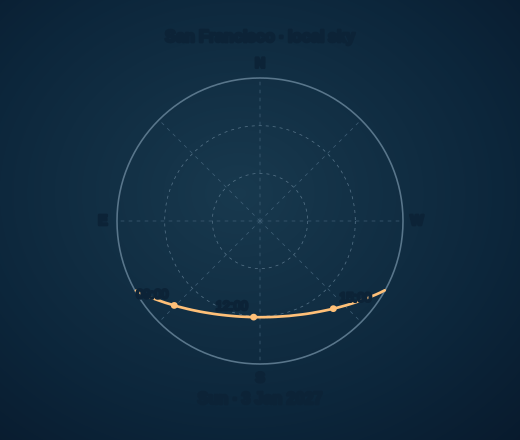
Download full-disk solar observations from January and July using the same instrument and pixel scale. Measure the outer diameter, keeping any automatic fit-to-window resizing out of the comparison. A chart of the celestial sphere helps translate an event’s position into a direction from your observing site. Over centuries, axial precession changes the reference directions used on modern sky charts.