

LIBRE TELESCOPE
Menu
Book Event

Sky Guide

The Butterfly Galaxies

NGC 4567

Quick Stats

Name:
The Butterfly Galaxies (NGC 4567)
Type:
Object
Observability:
Difficult
Best telescope for viewing:
Sky-Watcher Classic 250P 10-inch Dobsonian — to separate the brighter galaxy cores before looking for tidal structure.

How to view NGC 4567

  1. Plan around meridian passage

    Try May 4–8, 2027. At its highest the field is about 67° above the horizon in Los Angeles and 54° in Seattle. Use your city’s meridian time for the best view.

  2. Find the field

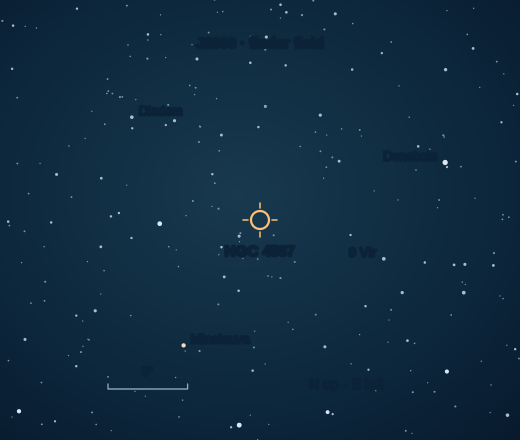
    On the north-up chart, start at Vindemiatrix. The target lies about 6.3° west of it. Match the surrounding stars before changing magnification.

  3. Check the identification

    The catalogued long axis is 2.74 arcminutes. Compare the central light with the field just outside it. Sketch the edge you can repeatedly recover with a side glance.

Best telescope for viewing NGC 4567: Sky-Watcher Classic 250P 10-inch Dobsonian — to separate the brighter galaxy cores before looking for tidal structure. on Amazon

A closer look at NGC 4567

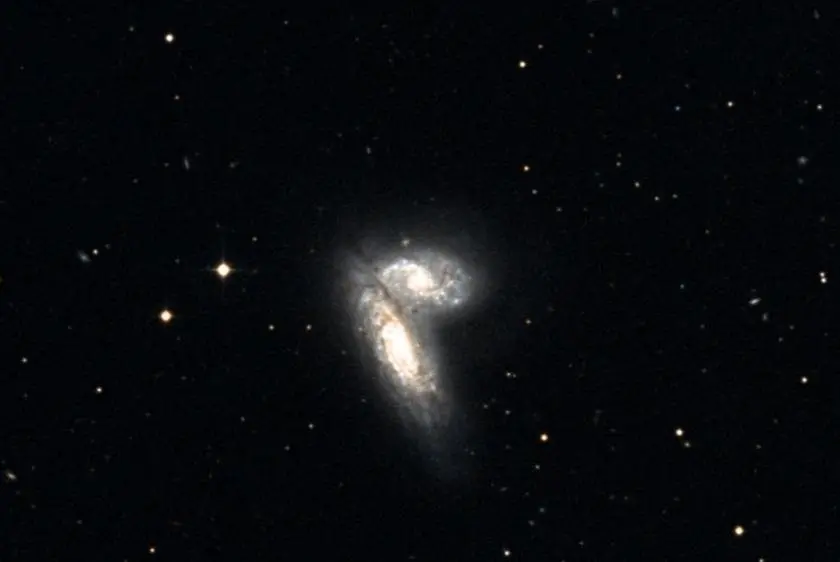
The Butterfly Galaxies are two spirals in Virgo whose disks overlap in projection. Their bright centers can be separated more easily than the faint structures along the contact region.

The catalogue position identifies NGC 4567 within the system. Its visual magnitude is about 11.3, so the brighter central light is a better visual starting point than any extended tidal features.

Begin at Vindemiatrix on a north-up chart and move about 6.3° west. A dark-adapted side glance helps separate the center from the fainter disk.

Want to learn more about the Butterfly Galaxies? NGC 4567 and NGC 4568 on Wikipedia.