

LIBRE TELESCOPE
Menu
Book Event

Sky Guide

The Beehive Cluster

M44

Quick Stats

Name:
The Beehive Cluster (M44)
Type:
Object
Observability:
Naked eye
Best telescope for viewing:
Celestron Cometron 7×50 binoculars — for a field wide enough to include the main group and outlying stars.

How to view M44

  1. Plan around meridian passage

    Try March 6–10, 2027. At its highest the field is about 76° above the horizon in Los Angeles and 62° in Seattle. Use your city’s meridian time for the best view.

  2. Find the field

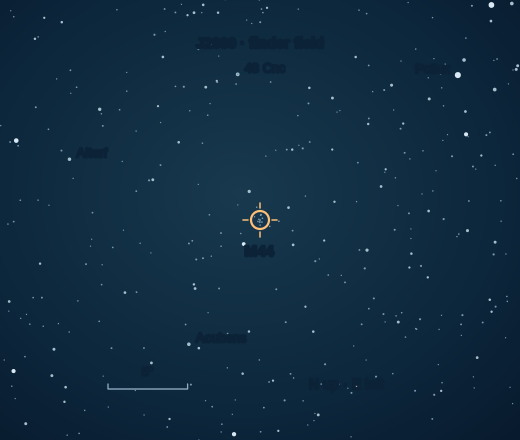
    On the north-up chart, start at Pollux. The target lies about 15.0° southeast of it. Match the surrounding stars before changing magnification.

  3. Check the identification

    The catalogued long axis is 108.6 arcminutes. Keep a few field stars beyond the cluster in the eyepiece. Compare the density in the middle with the density near the edge.

Best telescope for viewing M44: Celestron Cometron 7×50 binoculars — for a field wide enough to include the main group and outlying stars. on Amazon

A closer look at M44

The Beehive, M44, is an open star cluster in Cancer. Under a dark sky it looks like a small cloud in a rather faint constellation.

The glow contains a large family of stars moving together. The bright members you can pick out are only a fraction of the population.

Look unaided, then switch to binoculars. The transformation from cloud to a field of distinct points is the most satisfying part of this target.